Department: Office of Research


Landmark Aging Study by UT Health Sciences Researcher Published in Nature

|
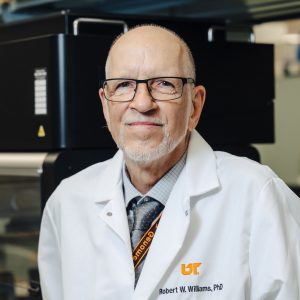
Portrait of Dr. Rob Williams in the lab

A University of Tennessee Health Sciences researcher has published findings that could reshape how medicine approaches aging, longevity and late-life health, including the prospect of personalized interventions that keep people healthier longer. Rob Williams, PhD, professor and chair of the Department of Genetics, Genomics, and Informatics in the College of Medicine, is the lead author… Read More


From Honeymoon to Pitch Table: UT Health Sciences Graduate Student Embodies ‘Discovery to Impact’

|
Portrait of CJ Rudolph in the lab with a scoliosis brace on the counter next to him.

On June 18, CJ Rudolph landed in Memphis at 1 a.m. after nearly 24 hours of travel home from his honeymoon. By mid-day, he was standing before a room of researchers, investors and industry leaders pitching a medical device he had spent three years developing. Hours later, the third-year University of Tennessee Health Sciences biomedical… Read More


Researcher Receives $466,000 Federal Grant to Study Eye Damage from Chemical Warfare Agents

|
Dr. Nawajes Mandal looks into a microscope

Nawajes Mandal, PhD, professor of Ophthalmology at the University of Tennessee Health Sciences, has been awarded a $466,103 grant from the National Eye Institute (NEI), part of the National Institutes of Health, to investigate how chemical warfare agents, specifically blister agents like mustard gas, damage the eyes and cause long-term vision loss. Blister agents like… Read More


Innovation Developed by UT Health Sciences Research Program Passes Landmark Trial for Cardiac Amyloidosis

|
Portrait of Dr. Jon Wall sitting in a lab in front of shelves containing scientific instruments and materials

A new diagnostic tool developed at the University of Tennessee Health Sciences may soon make it significantly easier for physicians to detect cardiac amyloidosis, a progressive and frequently underdiagnosed disease caused by abnormal protein deposits in the heart. The tool is a novel imaging technology, a radioactive molecule that, when injected into a patient and… Read More


Brain Chemical Could Hold Key to Helping Veterans Escape Cycle of Trauma and Alcohol

|
Headshot of Dr. Bryan Cruz

Why do people engage in compulsive behaviors? It’s a question Bryan Cruz, PhD, has been turning over since his undergraduate days, and one that became impossible to set aside as he watched people close to him struggle with compulsive and addictive behaviors that didn’t fit neatly into simple explanations. What others might attribute to personality… Read More


Mid-South AI Research Consortium to Fuel Innovation

|
Peter Buckley, Glenn Boyce, Charles Robinson, and Bill Hardgrave sit side-by-side at a table while announcing the Mid-South AI Research Consortium

Recognizing the unprecedented surge in artificial intelligence infrastructure and investment across the Mid-South, the University of Tennessee Health Sciences, University of Arkansas, the University of Memphis, and University of Mississippi announced Monday the formation of the Mid-South AI Research Consortium. This collaboration seeks to unify the region’s fragmented AI capabilities into a scalable ecosystem, leveraging… Read More


Looking for Answers Before Birth: How 2 UT Health Sciences Researchers Are Re-examining Childhood Obesity

|
Portrait of Dr. Hyo Young Choi and Dr. Qi Zhao posing side by side

Childhood obesity is often framed as a problem of habits, including what children eat, how much they move, and the environments in which they grow up. But researchers at the University of Tennessee Health Sciences began asking a different question: what if some of the risk for obesity is set in motion long before a… Read More


Research from UT Health Sciences Adds Insight to FDA Nutrition Label Proposal

|
Dr. Huang standing in a blazer against a railing in a building

When Yuru Huang, PhD, an assistant professor in the Department of Preventive Medicine at the University of Tennessee Health Science Center, talks about nutrition policy, she doesn’t start with statistics or regulatory language. She starts with the grocery store. Picture a busy shopper, she says, reaching for familiar items — chips, cereal, snacks — moving… Read More