

In the lab, promising results often lead to more questions than a researcher has the resources to answer.
For Mona Kazemi Sabzvar, a doctoral student at the University of Tennessee Health Sciences, preliminary findings in her research on blood cancer pointed toward an additional avenue worth exploring. She had ideas for the experiments that could help her investigate it, but she needed funding to move forward.
The Alma and Hal Reagan Fellowship provided that opportunity, allowing her to purchase laboratory supplies and incorporate the additional research into her dissertation.
Kazemi Sabzvar is one of two recent recipients of fellowships from the College of Graduate Health Sciences that support research into major health challenges. Daniel Nnamani, recipient of the Frank W. Dugan Fellowship, is studying the biological mechanisms connecting diabetes, obesity and cardiovascular disease.
Their research illustrates how fellowship support can help graduate students pursue promising ideas and contribute to the understanding and treatment of complex diseases.
Connecting Diabetes and Heart Disease
Nnamani came to UT Health Sciences in 2022 after earning a bachelor’s degree in pharmacy from the University of Nigeria and spending four years practicing pharmacy while volunteering as a research assistant. His early research focused on using nanoparticles to improve the delivery of metformin, a medication commonly used to treat diabetes.
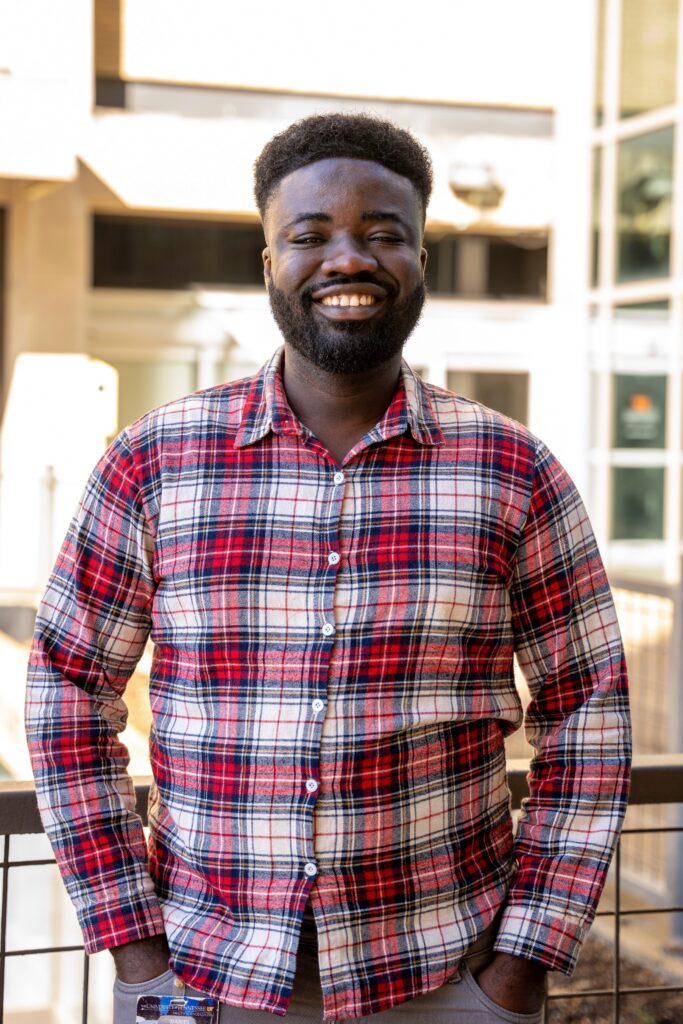
At UT Health Sciences, he has expanded his focus to diabetes, obesity and related metabolic disorders. He works in the lab of Maxwell Gyamfi, PhD, assistant professor in the Department of Pharmaceutical Sciences, examining the pregnane X receptor (PXR), a protein that helps regulate the metabolism of drugs and lipids.
PXR is involved in the metabolism of approximately half of all marketed medications, making it an important subject of study. Dr. Gyamfi’s lab is investigating whether the receptor also plays a role in the development of metabolic diseases and their complications. Nnamani’s work has also helped expand the lab’s research into the relationship between PXR signaling and cardiovascular disease.
“Daniel has played a pivotal role in expanding my laboratory’s research program,” Dr. Gyamfi said. “His work has extended our established expertise in PXR biology into an important and emerging area of biomedical research, generating novel insights and strengthening the translational impact of our studies.”
One area Nnamani is investigating is why diabetes and cardiovascular disease can affect men and women differently. Clinical research has identified differences in disease risk and outcomes between the sexes, but the biological mechanisms behind those differences are not fully understood.
“We wanted to understand what was going on,” Nnamani said. “This would give us the first step toward developing therapies and to see if these therapies will work similarly in both males and females.”
His research has already revealed differences in how male and female subjects respond to diabetes in relation to PXR. In males, the receptor appeared to promote diabetes, while in females, the researchers observed the opposite effect. Further investigation could help explain these differences and their implications for cardiovascular health.
For Nnamani, the work has both scientific and personal significance. Diabetes and cardiovascular disease are widespread public health concerns, and he has family members who have experienced diabetes and hypertension.
“This recognition motivates me to continue pursuing work that could make a meaningful difference in people’s lives.”
Daniel Nnamani
The Frank W. Dugan Fellowship provides $2,000 annually, along with $500 for travel or research supplies. The award will help Nnamani cover a portion of his stipend, purchase laboratory reagents and attend conferences where he can present his findings to other researchers.
“Fellowships and other forms of student support provide critical resources that enable trainees to devote more time and effort to their research while accelerating their professional development,” Dr. Gyamfi said. He noted that conferences give students like Nnamani opportunities to receive feedback from experts, expand their professional network and strengthen their scientific communication skills.
For Nnamani, the fellowship also affirms the value of his work and motivates him to continue pursuing questions with potential implications for patients.
“It is encouraging to see our research being recognized,” he said. “This recognition motivates me to continue pursuing work that could make a meaningful difference in people’s lives.”
Exploring New Blood Cancer Treatments
Originally from Iran, Kazemi Sabzvar studied cellular and molecular biology before earning a master’s degree in clinical biochemistry, where she began researching breast cancer. Now a doctoral student in pharmaceutical sciences at UT Health Sciences, she focuses primarily on blood cancers in a medicinal chemistry laboratory that combines chemistry and biology to investigate potential new treatments.

Her research examines experimental compounds synthesized by chemists in the lab to determine how they work against cancer cells. Specifically, she studies the mechanisms of action of compounds designed to target a protein involved in RNA splicing, a process cells use to prepare genetic instructions for protein production.
“Mona is a detail-oriented graduate student when working on new and challenging projects,” said Chao-Yie Yang, PhD, associate professor in the Department of Pharmaceutical Sciences and Kazemi Sabzvar’s mentor. “She has made significant contributions to our understanding of how the compound developed in our lab acts in leukemia cells with defects in RNA splicing.”
By understanding how the compounds affect cancer cells, Kazemi Sabzvar hopes to help advance promising approaches toward preclinical studies, an important step in evaluating potential treatments before they can be tested in people.
Her interest in cancer research is driven by both scientific curiosity and personal experience. She has lost someone close to her to cancer and hopes her work will eventually contribute to better treatment options for patients.
“Although I really like to be with patients, I always wanted to be on the scientific side,” she said. “I would love to discover new things in the field to help others, like physicians, help patients.”
During her doctoral research, Kazemi Sabzvar encountered preliminary results that suggested another promising avenue of investigation. Although her primary project had a defined direction, she wanted to explore a second pathway that could provide additional insight into the compounds’ effects.
The challenge was finding the resources to investigate it. After developing a proposal and receiving the fellowship, she was able to purchase antibodies and laboratory assays needed to pursue the additional experiments. The results from that work are now part of her dissertation.
“These grants change something in the scientists. They make them more excited, more hopeful about their future. They start to trust their ideas.”
Mona Kazemi Sabzvar
The Alma and Hal Reagan Fellowship provides $12,000 annually, along with $1,000 for research expenses such as supplies, books and travel.
For Kazemi Sabzvar, the fellowship has offered more than the ability to buy supplies and expand her research. It has also strengthened her confidence in her ideas and her connection to the university.
“To be very honest, it made me feel like I was part of the community,” she said. “I felt like I belong to UT Health Sciences.”
That sense of recognition has stayed with her as she plans to complete her doctorate this fall and pursue postdoctoral research opportunities, with the goal of continuing to study blood cancers and contribute to translational research that brings scientific discoveries closer to patient care.
Reflecting on the fellowship’s impact, Kazemi Sabzvar emphasized the lasting value of investing in graduate researchers.
“These grants change something in the scientists. They make them more excited, more hopeful about their future. They start to trust their ideas,” she said. “The change in the person who’s been awarded is much bigger than the money. The money is great, but it is more important that you can follow your dream.”
Investing in the Next Generation of Researchers
For both students, the fellowships have provided practical support for research while encouraging them to pursue questions that could inform future advances in healthcare.
“Supporting student research in cancer and cardiovascular disease is an investment in addressing two of Tennessee’s most pressing health challenges,” said Susan Miranda, PhD, associate professor, co-director of the Biomedical Sciences PhD Program and interim assistant dean for recruitment and enrollment.
“These scholarships bring the UT Health Sciences strategic priorities to life by promoting educational excellence, expanding research, advancing health and developing the next generation of scientific talent,” Dr. Miranda said. “By giving promising students opportunities to pursue discovery, we help prepare them to improve lives across our state and beyond.”
For Nnamani and Kazemi Sabzvar, that investment has provided more than financial assistance. It has given them the resources to pursue promising research questions, develop as scientists and take the next steps toward careers dedicated to improving human health.