
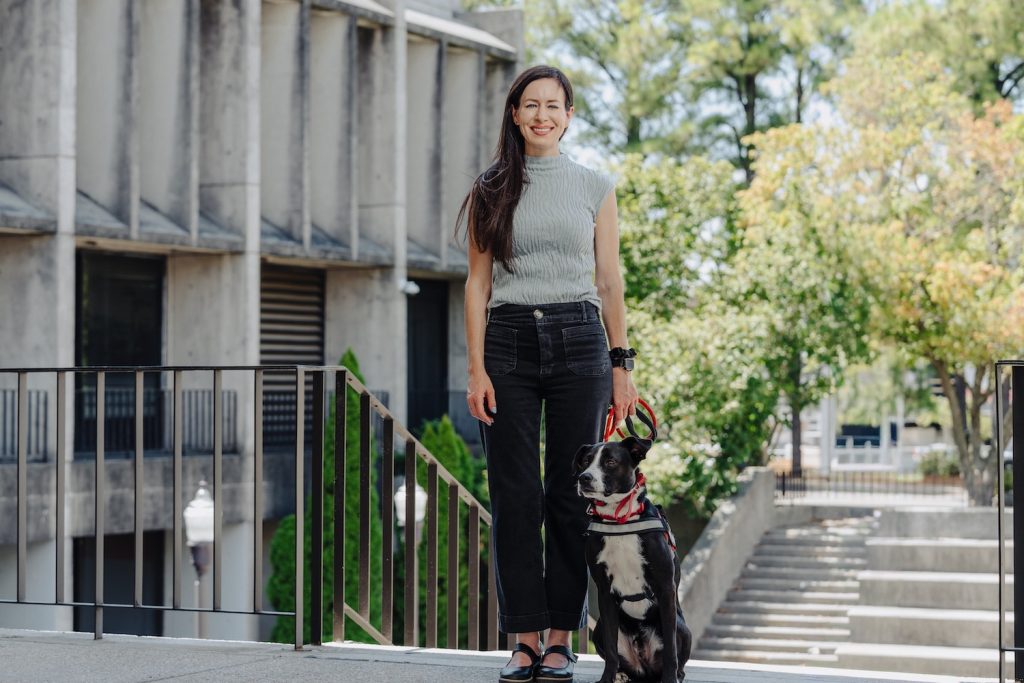
Fifteen years ago, Corinne Webster spent her days waving from the back of a 27-foot hot dog.
She was one of 12 people nationwide chosen to drive the Oscar Mayer Wienermobile, crisscrossing the country in her twenties for a job that mixed public relations with pure spectacle. It sent her from city to city with no fixed address and taught her something that shows up in how she works. The best opportunities rarely come with a finished plan attached.
That experience led her somewhere she didn’t expect. Now, Corinne Webster, PhD, LPC-MHSP, she serves as director of Wellness at the University of Tennessee Health Sciences, a newly created role connecting wellness efforts across the university’s Memphis, Nashville, Knoxville and Chattanooga campuses.
Students are most likely to meet Dr. Webster through outreach and prevention programming rather than a private session. She oversees Student Counseling Services and supervises the counselors who provide therapy directly to students. “I speak on behalf of Student Counseling Services, provide recommendations for supporting students with mental health concerns and can assist with threat assessment if needed,” Dr. Webster explained.
She also co-leads alcohol and drug use education with Mark MacNamara, director of Student Success Strategic Initiatives, serves as the mental health and wellness representative on UT Health Sciences’ CARE Team and represents UT Health Sciences for the University of Tennessee System Mental Health Collaborative.
From Classroom to Counseling Center
Dr. Webster’s trek to Memphis essentially started with a communication degree at the University of Texas, a master’s in counseling from Texas Woman’s University and a doctorate in counseling from the University of North Texas.
Along the way, she taught seventh grade, worked as a K-12 school counselor and spent time doing inpatient work at a state behavioral health hospital in Wyoming. She later became a professor of counseling at Oregon State University and the University of Tennessee at Chattanooga, preparing both school and clinical mental health counselors for licensure.
Dr. Webster has sat on both sides of the desk, as the counselor and as the person preparing counselors, and said she carries pieces of every stop with her.

Nature Enters the Picture
When the pandemic pushed her teaching online, Dr. Webster moved her work to the University of Oklahoma and, with her dog riding shotgun, spent a stretch of years touring national parks from a van. The unstructured time outdoors became more than a break. It became personal evidence of something she had only studied before.
“Nature and animals have always been a huge piece of wellness for me,” she said. “It’s such a peaceful way to reconnect.”
That period left her with a belief she still holds close today. Wellness isn’t only what happens in a counseling session. It’s the quality of the space a student walks through on the way there.
Coming Home to Something Bigger
Dr. Webster returned to Chattanooga, where she took over as director of the UT Chattanooga Counseling Center, overseeing a staff of 12. There she and colleague Carisha Northcutt, a counselor in the center, won the inaugural Well-Pitched UT Wellness Mini-Grant Competition this year for a dialectical behavior therapy program supporting students dealing with chronic stress and suicidal thoughts.
This caught the attention of colleagues across the UT System, including Jessi Gold, MD, the system’s inaugural chief wellness officer and an associate professor of psychiatry at UT Health Sciences, who had partnered with Dr. Webster on system wellness initiatives.
“I have consistently been impressed by her care for people and her ideas,” Dr. Gold said.
Dr. Webster eventually found herself ready for a change, and she began looking for a role focused more on vision and strategy than day-to-day management. When the position opened at UT Health Sciences, it lined up with exactly what she was hoping for next.
“The addition of a director of Wellness marks an important milestone for UT Health Sciences and our commitment to fostering a culture of wellbeing across our institution,” said Charles Snyder, PhD, vice chancellor for the Office of Student Success at UT Health Sciences.
“We have long recognized the need for focused leadership in this area, and we are fortunate to have found an exceptional candidate in Dr. Webster. Her innovative thinking, dedication to student and employee success, and passion for creating healthy, supportive environments make her uniquely qualified for this role.
“Corinne will be instrumental in helping us advance a comprehensive vision for wellness that supports students, faculty and staff alike. I am delighted to welcome her to the Student Success team and honored that she chose to continue her service to the UT community in this new capacity.”

The One Missing Piece
UT Health Sciences hasn’t lacked people who care about student wellness. Faculty, staff and the Office of Student Success have been developing programs and support systems across campuses.
“I think the only thing that’s been missing is somebody to rally it all together,” Dr. Webster said.
Dr. Gold sees the same solution from a system level. “It takes a real unifier of people and ideas to put it all together, and that’s what Corinne is,” she said. “She has the right mix of on-the-ground knowledge, clinical care, teaching experience and leadership to determine what our students really need and turn that into clear, measurable, evidence-based action.”
Dr. Webster’s early priorities reflect this. A campus-wide needs assessment is underway alongside plans to hire counselors at UT Health Sciences’ other locations. This fall brings an overdose awareness event, monthly Narcan training sessions, a Take Care Fair tied to National Suicide Prevention Month and Connect events with the Office of Student Success. Additionally, she’s planning Mental Health First Aid training for the campus community and contributing to wellness-centered spaces.
Her work also links to a larger system effort. Starting Aug. 31, the UT System is launching UT Wellness: Know How, Know Now, a systemwide training series covering mental health warning signs, opioid overdose response and suicide prevention, timed to coincide with International Overdose Awareness Day and the start of National Suicide Prevention Month. Dr. Webster herself provided feedback on all the courses.
Campuses will compete for the highest series participation rate through Oct. 10, and employees who complete all three trainings can earn a digital certificate and a chance at a systemwide prize drawing.
A Culture Catching Up
One trend occupies much of Dr. Webster’s attention. More students than ever are seeking mental health support on their own, a shift she credits partly to social media normalizing the conversation. But in health sciences specifically, an old instinct persists, the fear that admitting a struggle might threaten a license or career.
“We’re doing a much better job, generationally, moving past that,” Dr. Webster said. “But culturally, within health sciences, we still have work to do.”
It’s the same instinct she recognizes from her own path, the ugly stretch before things click into place. She’s lived that more than once, a scary leap, an intimidating setting, an overwhelming expanse of time. She calls it the chrysalis moment, the point where a hard transition finally starts to look like growth. Now she’s helping health sciences students get there too.
Students with an urgent concern can call the CARE line at 901-448-CARE or use TimelyCare’s TalkNow feature for immediate support. For scheduled counseling or help finding the right referral, Student Counseling Services can be reached at [email protected] and 901-448-5056 or in person at Memphis’ Student-Alumni Center (SAC) at 800 Madison Ave. in Suite 312.