
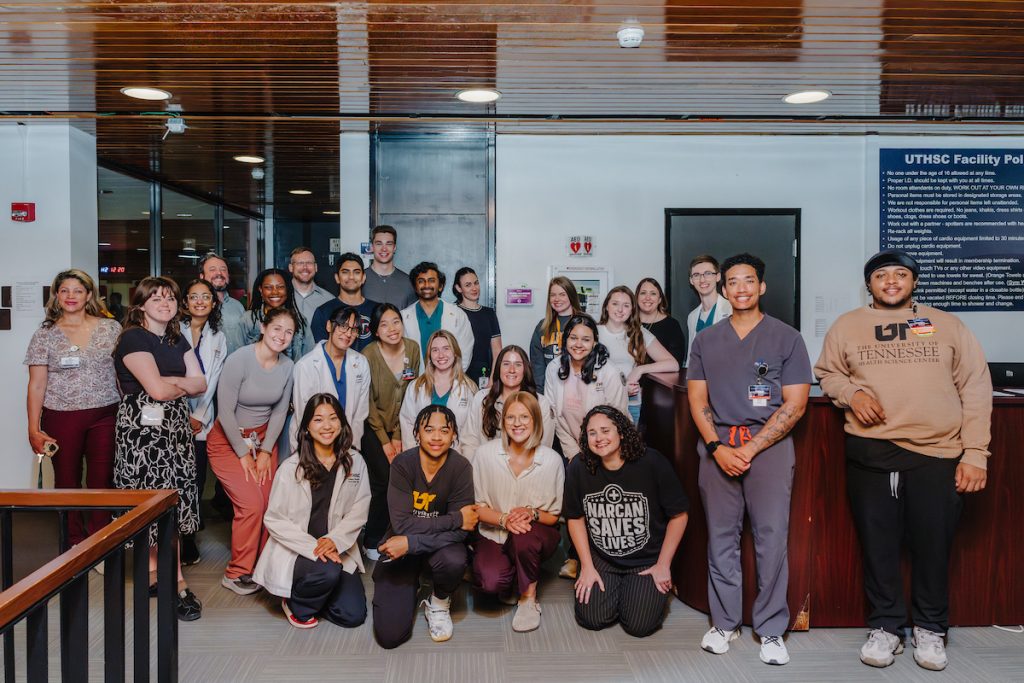
The University of Tennessee Health Sciences held a pilot naloxone training April 14, gathering a group of interdisciplinary students to dive deeper into overdose recognition and proper administration of intranasal naloxone. The event also kickstarted the Memphis campus OneBox effort, placing over a dozen naloxone overdose kits alongside existing automated external defibrillators in high-traffic locations across the downtown campus.
The timing is fitting. April brings a convergence of national health observances centered on harm reduction, overdose prevention, and naloxone access, including National Fentanyl Awareness Day on April 29. This created a natural moment for UT Health Sciences to continue to take steps forward in helping foster safe and healthy campuses, student life, and Tennessee communities.
The initiative is part of a system-wide effort spanning all University of Tennessee campuses, championed by UT System President Randy Boyd. Jessi Gold, MD, MS, chief wellness officer for the UT System and an associate professor of psychiatry at UT Health Sciences, helps coordinate the effort across campuses. At UT Health Sciences, the Office of Student Success has been the primary contact and grant recipient.
“When something could save somebody’s life tomorrow, it becomes a pretty quick priority,” Dr. Gold said. “We have the ability to normalize naloxone the same way we’ve normalized CPR and destigmatize that conversation in a state with high overdose rates.”
A Campus Ready to Respond
“The Office of Student Success works closely with CHASCo (Coalition for Healthy and Safe Campus Communities) to support the whole student, addressing wellness, safety, and physical and mental readiness as essential components of student success,” said Mark MacNamara, director of Student Success Strategic Initiatives as well as Military Affiliated Students, and interim director of Campus Recreation. “At UT Health Sciences, we believe preparing future health care providers means ensuring they’re supported, well‑trained, and ready to serve communities across Tennessee.
“Through our partnership with CHASCo, we’ve expanded access to naloxone and OneBoxes in student‑centered areas, reinforcing lifesaving training and integrating harm‑reduction practices into everyday environments. UT Health Sciences is uniquely positioned to prepare Tennessee’s future health care workforce with the skills and confidence needed to respond to the opioid crisis.
“As a veteran, this work is deeply personal to me and central to our mission of Healthy Tennesseans and Thriving Communities. Addressing the opioid crisis with intention, preparedness, and determination is both a responsibility and a reflection of who we are as an institution.”
Chasity Shelton, PharmD, associate dean of student affairs and a professor in the College of Pharmacy, also helped coordinate Tuesday’s event. First-year pharmacy students already receive naloxone overdose response education as part of their standard curriculum. Tuesday’s session extended that preparation to other students, who completed a skills check-off demonstrating they could administer naloxone correctly.
“We want to ensure all of our graduates enter the health care workforce with the skills and competence to recognize an overdose and activate emergency response,” Dr. Shelton said.
For first-year medical student Kayhan Mirza, the training built on experience gained working in a local emergency department. “When I saw the email come through, I wanted to learn more about what I’d already been exposed to,” Mirza said about the workshop offering.
Building Towards a Statewide Reach
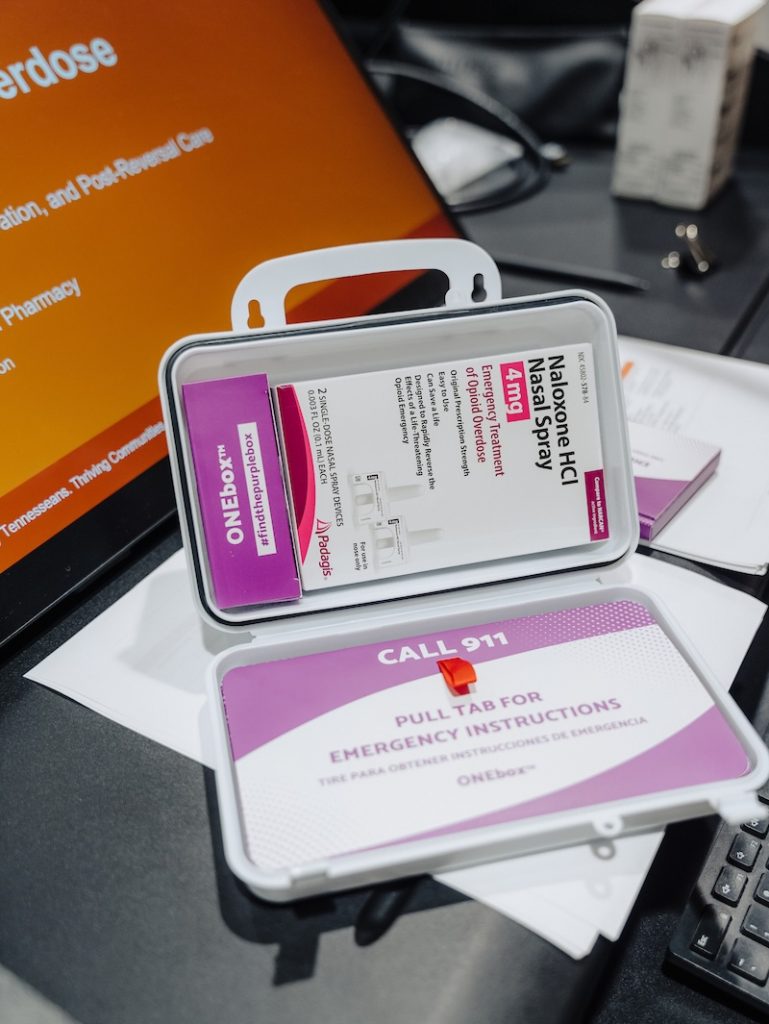
Tuesday’s session was a pilot, with strong interest already coming from health sciences students across all six colleges. Dr. Shelton plans to offer additional trainings to meet that demand. The systemwide partnership team is also developing an online naloxone training through K@TE, the UT System’s learning management platform, with a target launch later this year. Moreover, a larger interprofessional simulation is planned for June, led by Tara Lemoine, DO, executive director of the Center for Healthcare Improvement and Patient Simulation (CHIPS) at UT Health Sciences in Memphis. The program will walk students through a real-world overdose scenario using the simulation center.
The longer goal is for UT Health Sciences students, located across clinical sites statewide, to carry that training back to undergraduate UT campuses, their communities, and into their future practice. “As a first-year medical student, when you don’t know how to do everything yet, this is something you can do,” Dr. Gold said. “That’s empowering.”
For information about upcoming naloxone trainings at UT Health Sciences, contact the College of Pharmacy.