
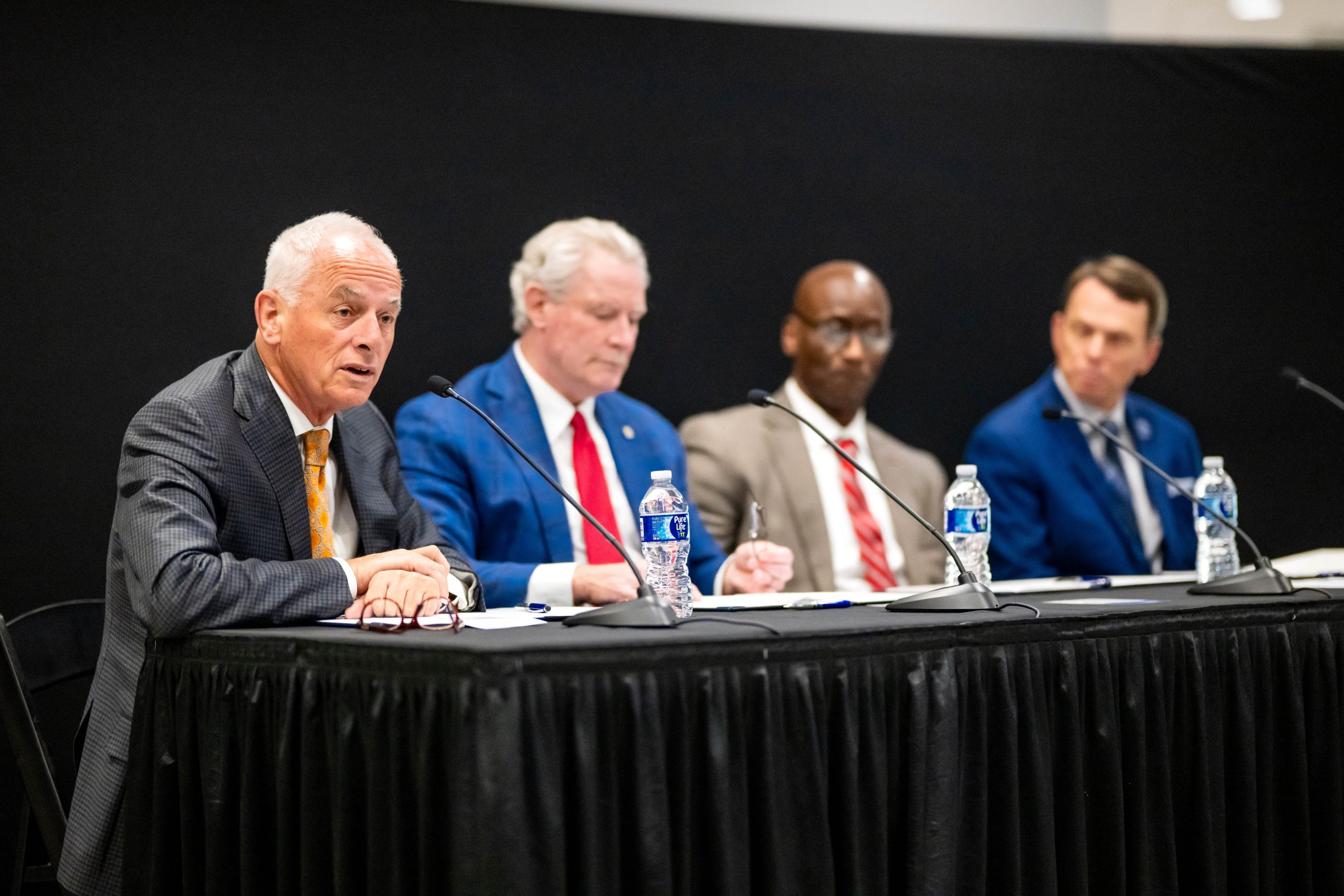
Recognizing the unprecedented surge in artificial intelligence infrastructure and investment across the Mid-South, the University of Tennessee Health Sciences, University of Arkansas, the University of Memphis, and University of Mississippi announced Monday the formation of the Mid-South AI Research Consortium.
This collaboration seeks to unify the region’s fragmented AI capabilities into a scalable ecosystem, leveraging the region’s status as a global hub for transportation, energy, and advanced computing. The consortium will provide a “living laboratory” for AI research, utilizing shared high-performance computing resources, real-world test beds and collaboration among the consortium’s world-class researchers.
“As someone who trained and served on faculty at the University of Arkansas for Medical Sciences, this collaboration is especially meaningful to me from my new home in Tennessee,” said Jessica Snowden, MD, vice chancellor for research at UT Health Sciences. “The Mid-South has always had the talent and domain expertise to lead in applied innovation. What this consortium does is connect those strengths across institutions in a way that accelerates discovery, workforce development, and real-world impact. This is how we translate regional assets into national leadership.”
The consortium will focus on five critical pillars of research and development:
- Rural & Precision Health: Addressing disparities through AI-enabled health care evaluation
- Supply Chain & Logistics: Partnering with industry leaders like FedEx and J.B. Hunt to secure next-generation global trade
- Energy & Data Centers: Solving the energy consumption challenges of massive supercomputers
- Agriculture & Food Security: Advancing sustainability analytics for the nation’s leading producers of rice, cotton and poultry
- National Defense: Supporting federal mandates to accelerate AI innovation for tactical readiness
“The Mid-South Delta region has been attracting significant AI data center investment,” said Jasbir Dhaliwal, PhD, executive vice president for research and innovation at the University of Memphis. “This collaboration involving several hundred PhD-trained AI research scientists and scholars at four Carnegie R1 universities anchors the new Digital Delta by providing the soft creative brain trust for applied AI efforts. It positions our tri-state region as a strong national hub for the exponential growth of AI, both as a science and economic development engine.”
“AI is rapidly reshaping the research landscape, and the time to be thoughtful and strategic is now,” said Glenn Boyce, EdD, chancellor of the University of Mississippi. “At Ole Miss, we have dynamic faculty across a wide range of disciplines, and this collaborative effort will enhance our ability to pursue meaningful research, to innovate, and to spur the economy of our region. We’re grateful to our partner universities in this endeavor and looking forward to working together to advance innovation in AI.”
The consortium is built on a “low overhead” model designed for rapid action, including joint federal grant applications and shared digital environments for faculty and students. The consortium will give particular emphasis to workforce development through upskilling opportunities for the region’s citizens and the students and graduates of the member institutions.
“Artificial intelligence is creating new possibilities in fields that are critically important to the Mid-South, from agriculture and logistics to health and energy,” said Charles Robinson, PhD, chancellor of the University of Arkansas. “By working together, our universities can help establish the region as a leader in AI innovation while strengthening key industries, preparing students for success.