

On June 18, CJ Rudolph landed in Memphis at 1 a.m. after nearly 24 hours of travel home from his honeymoon. By mid-day, he was standing before a room of researchers, investors and industry leaders pitching a medical device he had spent three years developing.
Hours later, the third-year University of Tennessee Health Sciences biomedical engineering PhD student walked away with $5,000 in seed funding.
Rudolph’s whirlwind day became an unexpected illustration of what UT Health Sciences’ inaugural “From Discovery to Impact: Entrepreneurship & Industry Partnerships in Health Sciences” workshop set out to accomplish: giving researchers a low-pressure environment where they could take the first step toward turning their science into real-world impact.
Organized by Jessica Snowden, MD, vice chancellor for Research, in partnership with the UT Research Foundation (UTRF), Life Science Tennessee and Launch Tennessee, the two-day workshop introduced faculty, graduate students and postdoctoral fellows to the commercialization process. Technology transfer experts, investors, entrepreneurs and faculty innovators shared practical advice on moving scientific discoveries from the lab into the marketplace.
The workshop concluded with a pitch competition, where graduate students and postdoctoral fellows presented their research as potential commercial ventures. Rudolph was one of three participants awarded $5,000 in seed funding. Graduate student Amir Davari earned funding for a drug and vaccine concept, while postdoctoral fellow Mohammed Khalifa was recognized for his drug development pitch.
For Rudolph, the experience capped an extraordinary 24 hours. His advisor, Denis DiAngelo, PhD, Distinguished Professor and program director in the Department of Orthopedic Surgery and Biomedical Engineering, had encouraged him to attend the workshop weeks earlier. But the dates conflicted with Rudolph’s honeymoon. When Rudolph landed back in Memphis in the early hours of the workshop’s final day, he wasn’t planning to participate. Then his phone started buzzing.
James Parrett, JD, PharmD, vice president of UTRF’s Memphis office, had specifically asked whether Rudolph would be there. That request carried weight. A year earlier, Dr. Parrett had given a guest lecture in Rudolph’s department as part of a UTRF entrepreneurship course. The presentation fundamentally changed how Rudolph viewed his research.
“That’s one of the biggest problems with grad school,” Rudolph said. “Professors and students will work on things for their whole career and never take it out of the lab. That’s what the whole goal should be, to take this to people that are actually going to use it.”
He credits Drs. DiAngelo, Parrett and Snowden with helping build that entrepreneurial mindset into his graduate training.
Running on roughly six hours of sleep and fueled by two cups of coffee, Rudolph arrived at the workshop with slides he had prepared a year earlier only to learn the competition would be entirely verbal. “I ended up trying to memorize the bullet points,” he said. “I felt like I was fumbling.”
When Dr. Snowden announced the winners, Rudolph was stunned. “I was like, ‘Wow, I guess I did OK.'”

His pitch focused on a longstanding challenge in pediatric scoliosis treatment. Children with scoliosis often wear a rigid plastic back brace for 18 to 23 hours each day. Traditional braces rely on straps with Velcro-style hook-and-loop fasteners that loosen over time, reducing corrective force while making the braces uncomfortable and restrictive.
Working alongside labmates Matthew Grosman and P.J. Johnson in Dr. DiAngelo’s laboratory, Rudolph helped develop the Constant Tension Unit, an accessory that replaces static hook-and-loop tension with laminated stainless-steel springs housed in a custom 3D-printed enclosure. The device maintains consistent corrective pressure while allowing patients to move and breathe more comfortably. “The first thing they say is, ‘Oh wow, I feel like I can breathe,'” Rudolph said.
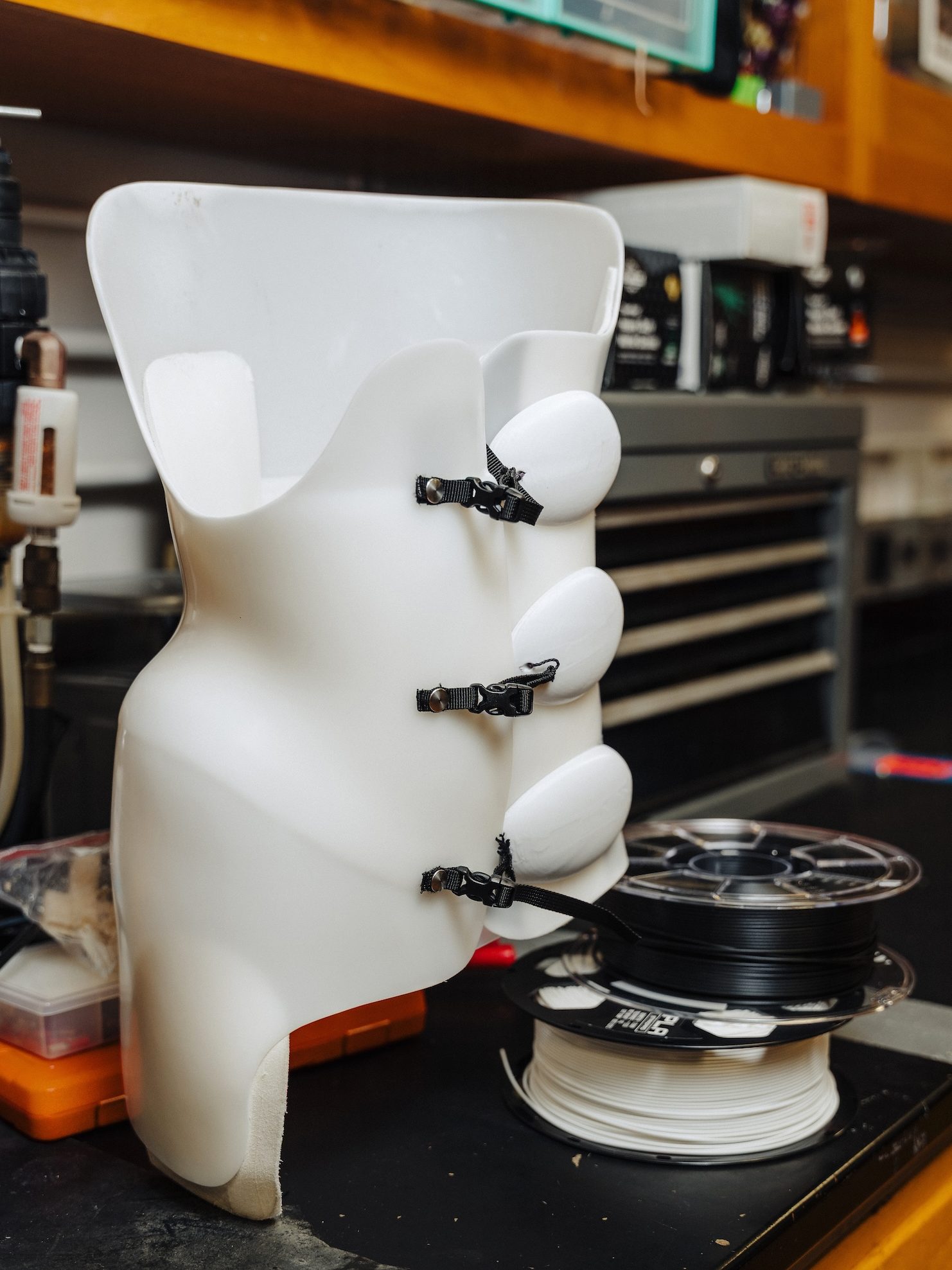
Early testing has shown the device maintains corrective tension more consistently than conventional straps while improving patient comfort. Because it functions as an accessory to an existing FDA-approved brace rather than replacing it entirely, the technology could face a more streamlined regulatory pathway. The team has already begun working with pediatric orthopedic surgeons at Campbell Clinic and Le Bonheur Children’s Hospital to evaluate the device.
For Dr. Snowden, Rudolph’s experience represents exactly the kind of culture UT Health Sciences hopes to foster. “It’s absolutely essential to get the research we’re doing in our labs out into the real world,” she said. “That’s the whole purpose.”
She sees entrepreneurship as both a strategy for expanding research impact beyond traditional grant funding and a powerful way to attract the next generation of scientists. “Entrepreneurship is something that really excites our younger generation of scientists,” Dr. Snowden said. “It becomes a really attractive engagement point for new students and even physicians going into research.”
Building that culture has required building relationships. Over the past two years, Dr. Snowden has worked to strengthen partnerships with organizations including UTRF, Epicenter, Life Science Tennessee, Launch Tennessee, the Tennessee Department of Economic and Community Development and the Greater Memphis Chamber. Those relationships helped bring industry representatives from companies including PBC Biomed and Charles River to the workshop as speakers, mentors and pitch competition judges.
“That has helped our community learn more about us and raise our visibility in a way that we really needed to do,” Dr. Snowden said.
The workshop itself grew out of one of those partnerships. Maha Krishnamurthy, PhD, president and CEO of UTRF, approached Dr. Snowden with the idea after identifying an opportunity through the Tennessee Technology Advancement Consortium (TTAC), a Launch Tennessee initiative that supports innovation and technology commercialization across the state.
“The path to turn research into a drug, device or diagnostic is many times obscure, not known, not taught,” Dr. Krishnamurthy said. Using TTAC support, UTRF partnered with UT Health Sciences to create an event that would demystify commercialization and introduce researchers to the people and resources that can help move discoveries toward patients. Dr. Krishnamurthy said the workshop exceeded expectations, particularly the faculty presentations that showed commercialization and academic research are complementary rather than competing pursuits. “It’s not either you do research or you do commercial,” she said. “It is a partnership strategy.”
That philosophy runs throughout the workshop and Rudolph’s story alike. Dr. Krishnamurthy helped create the opportunity. Dr. Snowden built the partnerships that made it possible. Drs. DiAngelo and Parrett encouraged a young researcher to take a chance on an unfamiliar stage. Rudolph simply showed up.
Jet-lagged, underslept and speaking without slides, he demonstrated what can happen when researchers are given accessible opportunities, practical mentorship and encouragement to think beyond the laboratory. As UT Health Sciences works to make that kind of support a fixture of campus life rather than a once-a-year event, CJ Rudolph’s honeymoon-to-pitch-table sprint may end up being remembered less as an outlier and more as a preview of what’s coming next.