

During its spring meeting Friday, the University of Tennessee Health Sciences Advisory Board unanimously approved the university’s balanced operating budget proposal of $747 million for Fiscal Year 2027.
The proposal, which goes before the UT Board of Trustees in June, includes $4 million for cost-of-living adjustments and $2.5 million for one-time performance-based compensation adjustments for employees, $1 million for institutional student scholarships, $150,000 to fund half of the increase in student health insurance premiums for the upcoming year, and $100,000 to help fund faculty promotions support. The proposal also includes funding for capital improvements, specific program expansion, and research support.
Prior to the FY27 budget proposal presentation, Chancellor Peter Buckley, MD, opened the meeting by reflecting on the university’s evolution over the past few years.
“The only constant is change, and we’re surrounded by change,” he said. He noted the board, too, is changing, as three members complete their terms and a new member begins service.
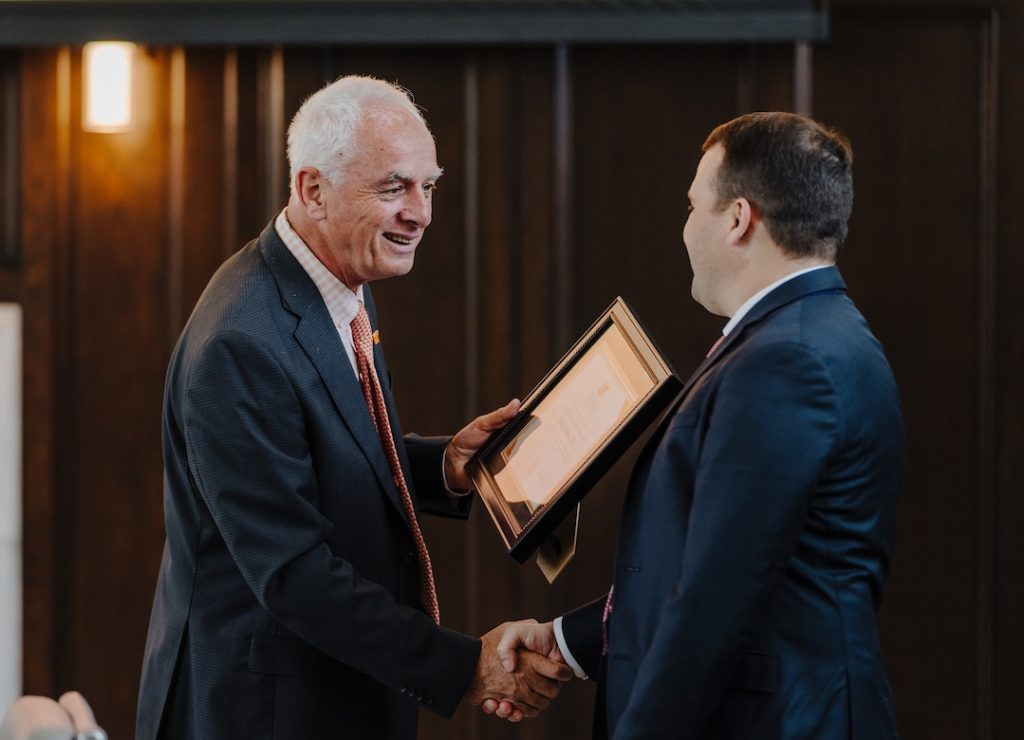
The chancellor thanked outgoing members Josh Wayman, DDS; Natalie Tate, PharmD; and Michael Ugwueke, DHA, for their service. He welcomed renowned Memphis ophthalmologist and dedicated alumnus Gary Passons, MD, to the board and thanked Randall Davis, MD, another stellar alumnus, for agreeing to serve another term on the board and continuing his role as chair.
Four years ago, the chancellor said, the university struggled with enrollment and substantial accreditation issues, research challenges, underdeveloped clinical partnerships, underappreciation for its statewide presence, and a sizeable budget gap.
“Today we have a clear vision: Healthy Tennesseans. Thriving Communities,” he said. The leadership team members, most of whom are newer to the university, are gifted leaders who are making an impact across all the missions, he said.
Enrollment has increased, new programs have been added, accreditation issues have been resolved, the university has received R1 research designation as a top-tier research institution, the institutional brand has been strengthened, and the statewide reach solidified.
Additionally, thanks to the outstanding work of Executive Vice Chancellor and Chief Operating Officer Raaj Kurapati, his team, and the entire university community, the budget is balanced, reserves are growing, and the institution is well-positioned financially to invest back into the enterprise.
The chancellor pointed to the recent approval of $311 million in state funding for the new College of Medicine Interdisciplinary Building as evidence of the university’s positive trajectory and impressive turnaround.
“We are now the recipient of the largest capital investment ever in higher education in the state of Tennessee,” he said. “You don’t get that without having your act together and without having a compelling story, mission, vision, and being on the right track.”
Welcoming a New Clinical Partner, Advancing Rural Health Together
UT Health Sciences’ statewide clinical presence is supported by partnerships at hospitals across Tennessee. Maury Regional Health in Columbia, Tennessee, is the newest with the College of Medicine’s primary care residency program in Internal Medicine at the hospital.
“We’re excited to welcome Maury Regional Health to the UT College of Medicine family and look forward to the impact this partnership will have on patient care throughout the region,” Vice Chancellor for Strategic Partnerships Paul Wesolowski said. The first partnership program with Maury Regional Health had a very successful first match, filling all 10 of the available positions. The inaugural cohort begins in July.

When the program reaches its full size in two years, there will be a total of 30 internal medicine residents in the community. The goal is to have the graduates stay in Columbia or practice in other rural areas of the state, Wesolowski said.
Wesolowski thanked Martin Chaney, MD, CEO of the hospital, and Christina Lannom, DO, chief medical officer for the hospital, for their leadership in establishing the partnership.
“I can say personally the hospital is very welcoming,” Wesolowski said. “It’s a great community. It’s a warm medical staff and it really does fit with our mission and vision. It’s the type of community we wish to support.”
Dr. Chaney, whose son is graduating from the UT Health Sciences College of Medicine, said the partnership “has delivered a degree of excellence and reputation that has been very good for Maury Regional and hopefully will be good for training the next generation of doctors, especially for rural communities.”
Rural Health Transformation in Tennessee
Wendy Likes, PhD, DNSc, dean of the College of Nursing, and Jessica Snowden, MD, vice chancellor for Research, reported on the university’s growing efforts to improve access to health care in rural areas across Tennessee, where 93 counties are considered as health professional shortage areas.
“Survival should not depend on your zip code,” Dr. Snowden said. “You shouldn’t be more likely to die of cancer because you live in a rural area.”
As the state distributes the $206.9 million allotted to Tennessee this year from the federal Rural Health Transformation Program, UT Health Sciences is well-positioned with its statewide presence, academic disciplines, and wide-reaching partnerships to collaboratively support and champion rural communities and programs in developing and maintaining sustainable efforts to improve access to care.
Drs. Likes and Snowden said compared to many other states, Tennessee is poised to make impactful improvements in rural health. The discussion highlighted how rural health has been a key strategic priority of Governor Bill Lee, and that the earlier gubernatorial Task Force on Rural Health had helped prepare the way for the latest statewide efforts.

It was also acknowledged that Phil Wenk, DDS, an alumnus and former inaugural chair of the of UT Health Sciences Advisory Board, served on that task force. Dr. Wenk, who continues to serve as Special Advisor to Chancellor Buckley, was also instrumental in developing the Healthy Smiles Initiative, a key effort in partnership with the Tennessee Department of Health for dental workforce development. Healthy Smiles is making a real impact on improving dental healthcare across Tennessee.
Additionally, the Tennessee Rural Healthcare Center of Excellence at UT Health Sciences acts as a convener to identify and solve problems, assist communities and programs, fund and disseminate community-driven solutions, and accelerate the adoption of technology to expand access to care.
Financial Stability and Sustainability
In presenting the budget proposal, Kurapati detailed the multiyear steps taken to get to the current stable and sustainable financial picture. These centered around building greater transparency of expenditures, a disciplined approach to managing finances, and investing in people, programs, and facilities.
A critical review of finances in FY24 identified several concerns, including the need to develop a multi-year strategy to address them, he said. With key support of UT System leadership, a plan was developed to move toward a balanced budget over the course of four-to-five fiscal years through expense management, elimination of redundant services, addressing deficit operations, and revenue generation.
“Through the good work of our colleagues across the institution, we were able to get the institution back on a positive financial trajectory in less than three fiscal cycles, as evidenced in the proposal we are now bringing our Advisory Board,” Kurapati said.
The current $747 million balanced budget proposal strategically invests in academic and research growth, supports capital infrastructure and allows for building strategic reserves, Kurapati said. He also thanked the entire university community for such a collective and impressive financial turnaround. He said that he expects the university to finish FY26 with a $35 million in reserves.
In closing the meeting, Chairman Davis praised the work done to stabilize the budget, achieve strategic growth and enhanced presence in multiple key areas within just a few years, and improve the outlook for the university in general.
“Over the last few years, I’ve never seen as much of a positive attitude and excellent potential as we have now and I am thankful for that,” he said.
The recorded webcast of the meeting is available to view on the Advisory Board website.