
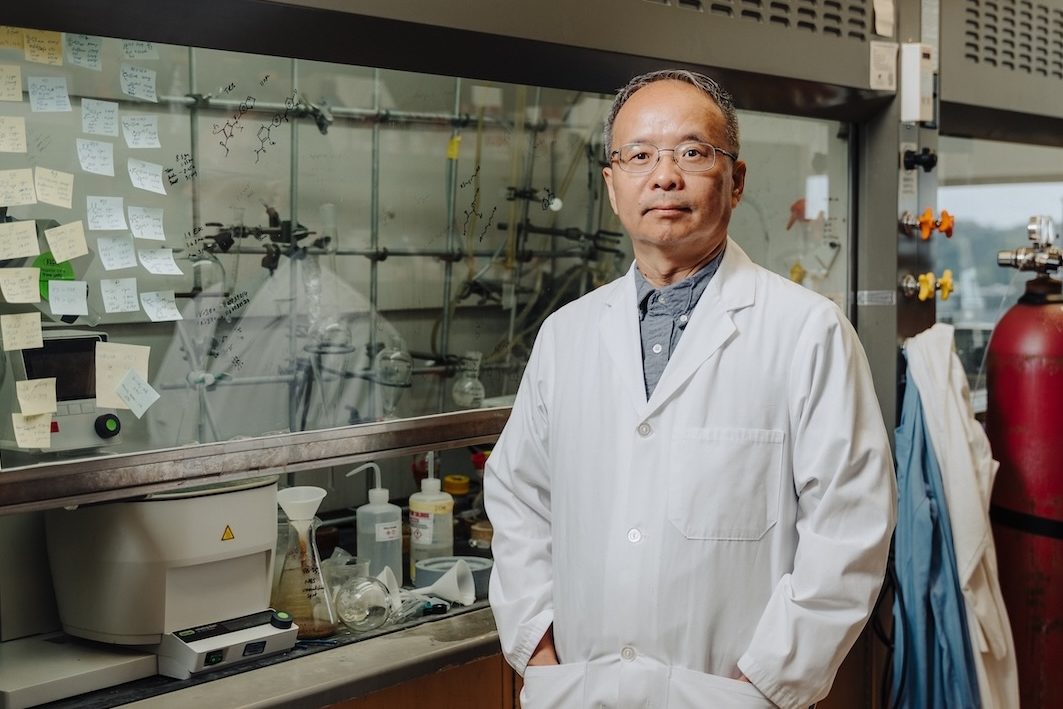
When Wei Li, PhD moved to Memphis in 1999, drug discovery was not necessarily what he thought he would be doing for a career.
Growing up in China, Dr. Li has always been passionate about chemistry, conducting home experiments after being introduced to the topic in middle school. He won the first-place prize in the experimental section of the 1987 Chinese Chemistry Olympiad competition for high school students.
“All my education centered on chemistry. My PhD is not really in drug discovery, it’s in physical organic chemistry,” says Dr. Li. “I think what I learned in college, how I was trained in PhD studies, prepared me well to branch out into medicinal chemistry and drug discovery.”
Initially hired as an instructor at the University of Tennessee Health Science Center tasked with overseeing instrumentation, he transitioned into drug discovery and ran with it, thanks to the mentorship of UT Health Science Center researchers such as Duane Miller, PhD, and Jim Dalton, PhD. Dr. Li would eventually secure a tenure-track position, establish his own research lab, and become a distinguished professor at the university. Today, he is a leading researcher in the UT Health Science Center College of Pharmacy, actively involved in developing promising drug candidates for various diseases.
Dr. Li’s contributions to drug discovery and development are a vital part of the College of Pharmacy’s reputation for research excellence, and contribute to the university’s R1 ranking among the nation’s top research institutions. In 2024, the college was ranked 12th among Colleges of Pharmacy in National Institutes of Health (NIH) funding. In total, the college secured over $20 million in grant funding the same year, highlighting its crucial role in driving global health care innovation. Since 2020, the college has consistently ranked among the top 15 NIH-funded institutions, reaching as high as sixth place in 2022.
Sabizabulin: A Promising Multi-Target Therapeutic in Oncology and Infectious Diseases
Sabizabulin was discovered through collaborative efforts among Drs. Li, Miller, and Dalton. In the early years of Dr. Li’s tenure at the college, the three researchers collaborated, sharing the task of designing, synthesizing, and testing a large number of compounds. It was a graduate student in Dr. Li’s lab, now Dr. Jianjun Chen, who eventually synthesized a promising compound that would ultimately be called Veru-111 or Sabizabulin, which went through multiple clinical trials as a potential treatment for castration-resistant prostate cancer or hospitalized COVID-19 patients.
Sabizabulin, derived from indole and imidazole components, is an orally administered molecule that targets microtubules, essential structures in the cell’s skeleton. By binding to specific sites on tubulin, a protein that forms microtubules, it causes their breakdown and prevents their formation. This action can slow tumor growth and inhibit the development of new blood vessels that supply tumors. The compound also interferes with the transport of cellular components, including androgen receptors, into the nucleus, indicating its potential as an anti-androgen medication.
Sabizabulin was tested in multiple clinical trials for prostate cancer and viral Acute Respiratory Distress Syndrome (ARDS). It is also in earlier stages of development for atherosclerotic cardiovascular disease, smallpox, and Ebola viruses. Additionally, Sabizabulin has shown promising results in blocking the transport of viruses, such as COVID-19, thereby helping to prevent their replication. By preventing microtubule formation, the drug may also decrease the release of inflammatory chemicals and modulate immune cell activity. This was exemplified in a Phase III clinical trial, which showed Sabizabulin reduced mortality by 55% in severe COVID-19 cases, according to Veru, Inc., which conducted a Phase 3 clinical trial.
The Innovative Development and Expanding Potential of JW-65
The development of JW-65 began when a faculty member in the UT Health Science Center College of Medicine was studying how a specific calcium channel called TRPC3 might be connected to the production of Beta-Amyloid, a substance involved in Alzheimer’s disease (AD). Later studies showed that blocking TRPC3 could reduce Beta-Amyloid levels in the brain. Although it was once believed that Beta-Amyloid caused neuron death in Alzheimer’s, newer ideas suggest it might actually be a sign of the disease. Still, lowering Beta-Amyloid remains a promising path for potential treatments, leading to a collaboration with Dr. Li to create compounds targeting TRPC3.
A molecule called Pyr-3 was reported as the most selective TRPC3 inhibitor at that time. However, Dr. Li and the lead chemist in his lab, Zhongzhi Wu, PhD, noticed two major issues with the compound: metabolic instability and toxicity. To address this, they made several compounds, including JW-65, which showed promising results in vitro. Unfortunately, shortly afterwards, the project was halted when the faculty member leading the biology portion left the university.
After the project lay idle for a few years, Dr. Li restarted the project by working with Francesca-Fang Liao, PhD, who is a UT Health Science Center College of Medicine Distinguished Professor and an expert in AD. Together Drs. Li, Wu, and Liao shared initial provisional patent costs before they published JW-65 and related compounds, while exploring new applications.
Dr. Li contacted Jianxiong Jiang, PhD, a researcher in the College of Pharmacy with a specialization in epilepsy. Dr. Jiang’s team discovered that the compound showed promise for treating epilepsy because it affects how calcium levels are managed in nerve cells and how excitable these cells are. Building on earlier research at the University of Arkansas, which found that removing the TRPC3 gene made seizures less severe in mice, Dr. Jiang’s team hypothesized that targeting TRPC3 could lead to new seizure medicines. Subsequent research showed that JW-65 can reduce seizures in animals, indicating it could be a helpful new treatment. Inspired by these promising results, the team secured a $1.14 million grant to further their research. Meanwhile, Dr. Li’s company, SEAK Therapeutics, obtained federal funding to develop JW-65 and attract a major pharmaceutical partner. Ultimately, the compound was licensed to a leading biotech firm, marking a significant milestone in its development.
Recently, with further creative efforts from Vijay K. Boda, PhD, a research associate from the Li lab, the team has significantly enhanced the compound’s potency and selectivity for TRPC3 inhibition. They are also investigating applications beyond epilepsy, including treatments for cardiovascular diseases, since ion channels such as TRPC3 are involved in both neurological and cardiac conditions. Currently, Dr. Li is finalizing the process of forming a collaboration with a leading researcher in another institution to test the compound and its related molecules in cardiovascular research.
SEAK193, a Highly Brain-Penetrable Molecule for Breast Cancer Brain Metastasis
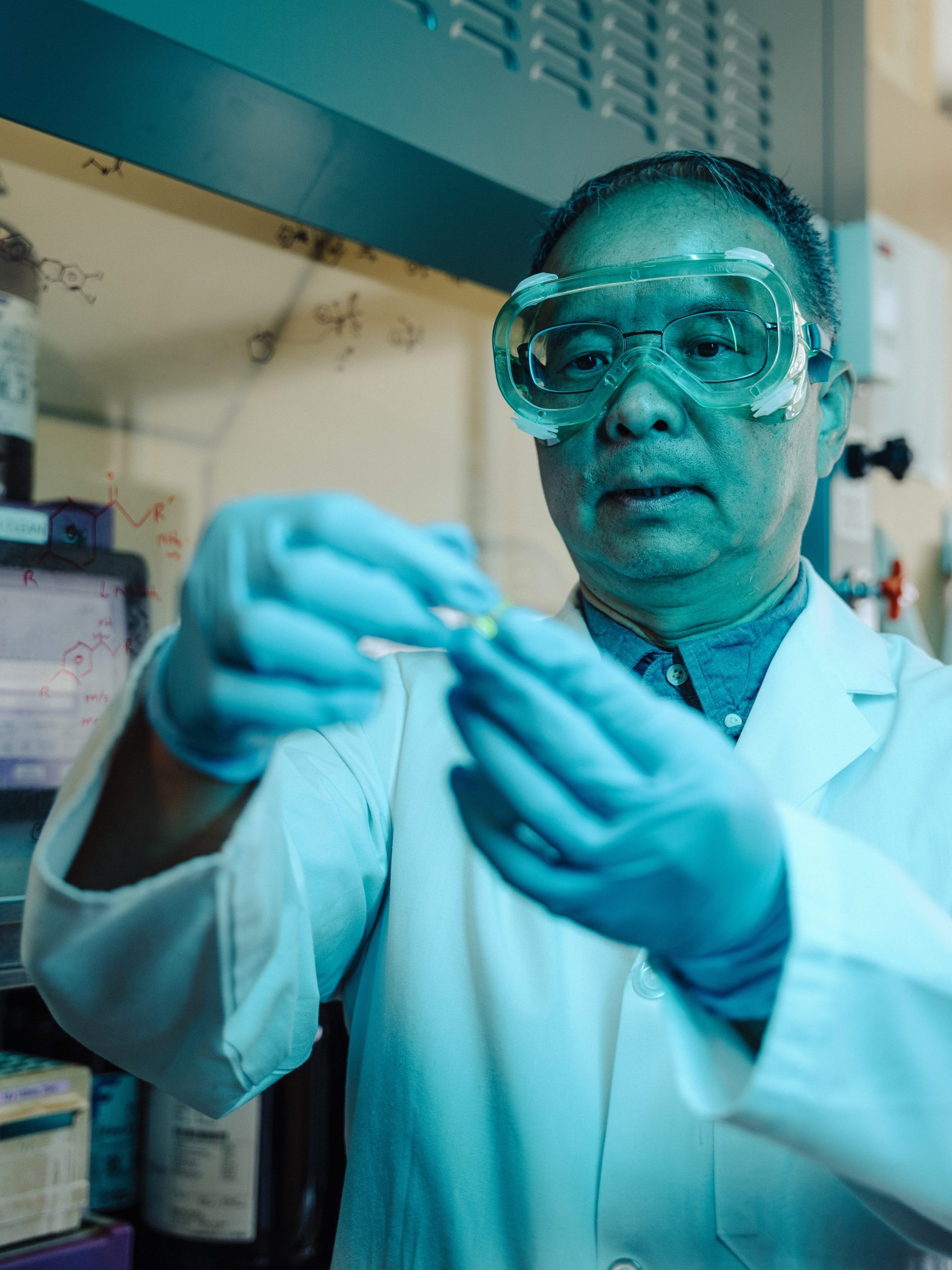
Compared to other common sites where breast cancer spreads, such as bones, liver, and lungs, patients with cancer that has spread to the brain face much more severe problems and have lower chances of survival. Although recent advances in breast cancer treatments have improved overall outcomes, the number of cases where cancer spreads to the brain is still increasing. This rise is likely because patients are living longer, giving more time for cancer cells to spread, and because current treatments are less effective at targeting cancer in the brain. Additionally, the blood-brain barrier, a natural protection of the brain, makes it difficult for many drugs to reach and treat brain metastases. In response to this challenge, Dr. Li has developed a new compound called SEAK193, which aims to help breast cancer patients with this serious complication.
The compound was first discovered through a collaboration between Dr. Li and Dr. Miller, funded by grants from the National Cancer Institute. Further collaborative studies with Tiffany Seagroves, PhD, a breast cancer expert now at Tulane University, showed that SEAK193 is highly effective in different cancer tests. It can also cross the blood-brain barrier, which means it could potentially treat brain metastases in breast cancer, as shown in animal experiments. This year, the University of Tennessee Research Foundation obtained a U.S. patent for SEAK193 and similar compounds, and in September, Dr. Li’s startup company received a $399,981 grant from NIH to comprehensively de-risk and develop SEAK193.
A Collaborative Effort Leads to Innovation and Success
Dr. Li expresses gratitude and highlights the key roles of others who have helped him in drug development over the years. “All of my research is a collaborative effort by many people,” he says.
He emphasizes the importance of his mentors in his early career, Dr. Miller and Dr. Dalton, his lab members, the University of Tennessee Research Foundation, the industry partners (GTx, Inc. and Veru, Inc.), as well as collaborators along the way, including Drs. Jiang, Liao, and Seagroves, among many others. Exemplifying dedication, a collaborative spirit, and ingenuity, Dr. Li continues to inspire aspiring researchers and sets a high standard of excellence in pharmaceutical sciences.