
Transformational investment officially launches private fundraising efforts for state’s largest higher education project
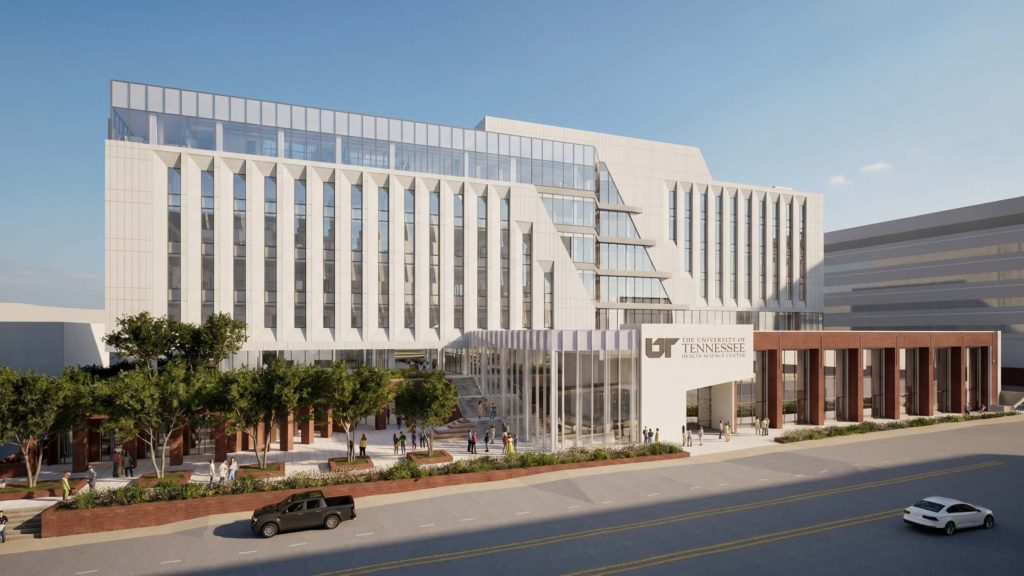
The University of Tennessee Health Sciences announced today that First Horizon Foundation has committed $5 million as a lead private investment in the new College of Medicine Interdisciplinary Building, part of the largest state-funded higher education capital investment in Tennessee history.
The First Horizon Foundation gift serves as a cornerstone of the project’s broader $50 million philanthropic campaign, which includes $39 million for capital needs and $11 million for programmatic support for the building. Together with the Tennessee General Assembly’s unprecedented $311 million investment, private support will help fund the $361 million initiative, including the $350 million College of Medicine Interdisciplinary Building to be constructed on the Memphis campus of UT Health Sciences.
“First Horizon’s leadership in this project is a powerful vote of confidence in the future of healthcare in our state,” said Peter Buckley, MD, chancellor of UT Health Sciences. “As the state’s academic health institution, UT Health Sciences educates the healthcare professionals who serve communities across Tennessee. This new home for the College of Medicine will enable us to train even more providers in an innovative and state-of-the-art environment. We are grateful to the First Horizon Foundation for helping launch this vital initiative and for its longstanding commitment to the health and well-being of our state.”

“UT Health Sciences is one of Tennessee’s most important assets and a leading engine for developing our state’s healthcare workforce,” said Bryan Jordan, chairman of the board, president and CEO of First Horizon Corporation. “The First Horizon Foundation is proud to play a part in bringing the vision of UT Health Sciences to life, preparing the next generation of physicians and health care professionals, and contributing to the health, economic vitality and prosperity of Memphis, the Mid-South and the state of Tennessee.”
The College of Medicine Interdisciplinary Building will help redefine healthcare education and workforce development in Tennessee. As the first true home for the largest of UT Health Sciences’ six colleges, the seven-story, more than 300,000-square-foot facility will bring together cross-disciplinary training, advanced technology, research and collaborative learning environments under one roof. Anchoring the Memphis Medical District, the building will expand the university’s capacity to prepare physicians, physician assistants and other healthcare professionals needed to meet growing workforce demands across Tennessee, particularly in rural and underserved communities.
“During its first five years, the facility is expected to train 1,450 new physicians and physician assistants, helping address projected provider shortages across the state,” said Michael Hocker, MD, executive dean of the College of Medicine. “As the academic cornerstone for the College of Medicine, this building will serve as the foundational training ground for all medical students. Regardless of where they ultimately complete their education in Chattanooga, Knoxville, Nashville or Memphis, the fundamental building blocks of their medical education will begin in Memphis, making this facility imperative to UT Health Sciences’ statewide educational delivery model and its mission to prepare the next generation of physicians for Tennessee.”
HOK, a global design, architecture, engineering and planning firm based in St. Louis, Missouri, designed the building’s programming. Memphis-based firm, brg3s architects, designed the building in collaboration with HOK. Once all approvals are received from the state, construction is expected to begin in late 2026, with full occupancy by 2030.
“We are grateful to First Horizon Foundation for its leadership in this transformative effort for not only UT Health Sciences but for the health and healthcare of all Tennesseans,” Chancellor Buckley said. “This investment helps catalyze a project that will strengthen healthcare education, expand our workforce pipeline and improve access to care across the state for generations to come.”