
The first time Chace Hicks, MD, came to Chattanooga, he was looking for a place to learn.
A few years later, he’s walking through the same halls he once trained. This time, as faculty.
After completing his general surgery residency training following medical school in 2025 at the University of Tennessee Health Sciences College of Medicine – Chattanooga and pursuing further fellowship training out of state, Dr. Hicks has returned to Chattanooga as an assistant professor in the Department of Surgery as of Sept. 1.
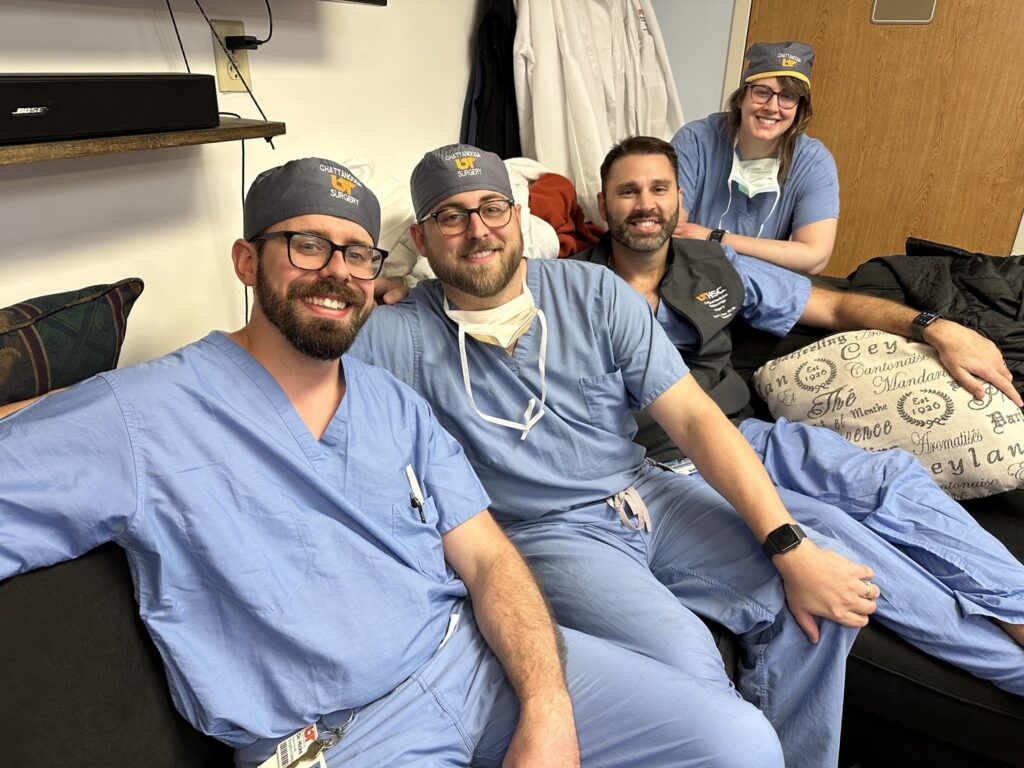
He also serves as a trauma and critical care supervising attending physician at Erlanger Health and as a surgeon with University Surgical Associates.
For Dr. Hicks, the return is more than a career move. It brings his journey full circle and gives him the opportunity to become the mentor he once relied on, and to help train the physicians who will care for patients across Tennessee and beyond.
His story reflects a central part of the College of Medicine’s mission: educating physicians prepared to serve their communities, and in many cases, choose to build their careers in the region where they trained.
From Trainee to Teacher
Originally from East Texas, Dr. Hicks hadn’t planned to leave Texas for residency. But after interviewing in Chattanooga and meeting members of the surgery faculty, he felt drawn to the clinical experience and the opportunity to learn in such a hands-on environment.
“They basically portrayed it as, this is one of the best experiences you’ll get in the country,” he said.
Over his six years of residency, Dr. Hicks found a culture centered on mentorship, hands-on learning and a shared commitment to patient care. Working alongside surgeons and healthcare professionals in multiple specialties, he said the willingness of faculty to teach became one of the defining parts of his experience.
“I knew that the goals of the faculty aligned with what I wanted to do,” he said. “And that was to provide exceptional care to the population here and also get to train people who you know are going to go out and do the same thing.”
During his fellowship training in Louisville, Kentucky, Dr. Hicks continued working with residents while gaining experience in a different academic environment. This reinforced something he started to recognize during his residency. Teaching would be an important part of the career he wanted to build.
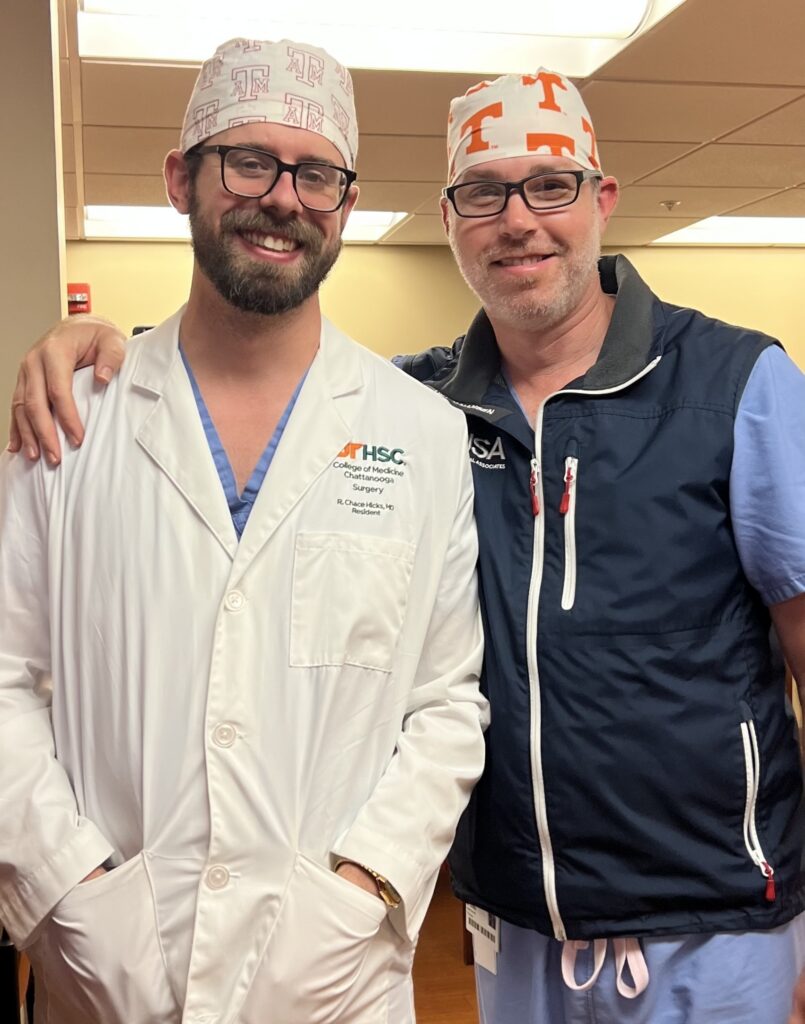
“Fellowship helped reassure me that was something I had to have in practice — that I would be involved with residents,” he said.
The desire to teach is part of a larger culture within the college, where many faculty members were shaped by the training environment they now help lead. Heath Giles, MD, professor and program director for Surgery, joined the program as faculty for the same reason.
“This is not the type of program where we were a private practice group, and the university came in and said, you now have to teach residents,” Dr. Giles said. “We took this job because we wanted to teach residents. That was why we joined UT Health Sciences and why Dr. (R. Phillip) Burns started University Surgical Associates in the late ’70s, with the primary purpose of both organizations to work together to train the next generation and take care of people.”
Now, Dr. Hicks has the opportunity to step into the role of the faculty members who once guided him and carry on the same commitment of mentorship and patient care.
Coming Back to the People Who Helped Build Him
Returning to Chattanooga has meant reconnecting with the nurses, staff and physicians who supported him throughout his residency.
Dr. Hicks describes them as “the people who helped raise me as a surgeon.”
For the mentors and nurses who remember him as an intern, his return offers a way to see how far he has come and recognize the role they played in his path.
“They get to see the finished product of what they helped build, even if they don’t think about it in that sense at the time,” he said.
This connection is part of what drew Dr. Hicks back.
During his residency, he developed a strong connection to the people and community surrounding his training. Returning as faculty allows him to continue that work while contributing to the educational environment that first helped him find his place in medicine.
His clinical work also keeps him closely connected to the patients and communities served by Erlanger, the university’s affiliated hospital partner.
Coming from an area without a major health system like Erlanger, Dr. Hicks sees the importance of having a healthcare system deeply rooted in the community.
“Erlanger serves such an important purpose,” he said. “It emphasizes caring for the community so much.”
For Dr. Hicks, coming back as faculty not only means coming back to the place where he trained but also continuing the work he saw modeled during his own education, caring for patients while helping prepare the physicians who will care for them in the future.
Building the Next Generation of Physicians
To Dr. Hicks, education is about more than passing along surgical knowledge. It’s a continuation of the support and mentorship he received throughout his own training.
“When you’re a medical student, the entire breadth of medicine and surgery is a possibility for you,” he said. “The whole world is available to you.”
He remembers being in that position himself.
“I think it broadens the impact you get to have when you train residents.”
Chace Hicks, MD
As a medical student, Dr. Hicks originally planned to pursue cardiology. It wasn’t until his surgery rotation that he discovered where he belonged.
“Two weeks into my eight-week surgery rotation, I was like, this is my thing,” he said. “This is where I’m supposed to be.”
Now, one of the most rewarding parts of teaching is watching students and residents explore that same process of finding their passions.
Some arrive certain about the specialty they want to pursue, only to discover something completely different during their clinical rotations. Others begin training without knowing exactly which direction they want to take.
As a faculty member, Dr. Hicks can now help guide those decisions in the same way his mentors once guided him.
“I think it broadens the impact you get to have when you train residents,” he said.
The residents he helps train will eventually carry the skills, experiences and lessons they gain in Chattanooga into communities throughout the state and nation.
A Growing Pipeline of Physicians Who Stay
Dr. Hicks’ return also comes as the College of Medicine – Chattanooga continues to see graduates choose to remain at Erlanger and practice in the region.
Over the past 10 years, nine graduates of the surgery program were recruited after residency to practice at Erlanger, four more at other medical centers within the Chattanooga region. In 2025, out of the eight residents in Dr. Hicks’ graduating class, 24% stayed to practice at Erlanger. Today, that figure has bumped up to 25%, continuing an upward trend in physician retention among graduates.
For the College of Medicine – Chattanooga, retention isn’t just a statistic. It represents the relationships physicians build, the clinical aptitude they gain and the connections they develop with their patients, colleagues and community during training.