
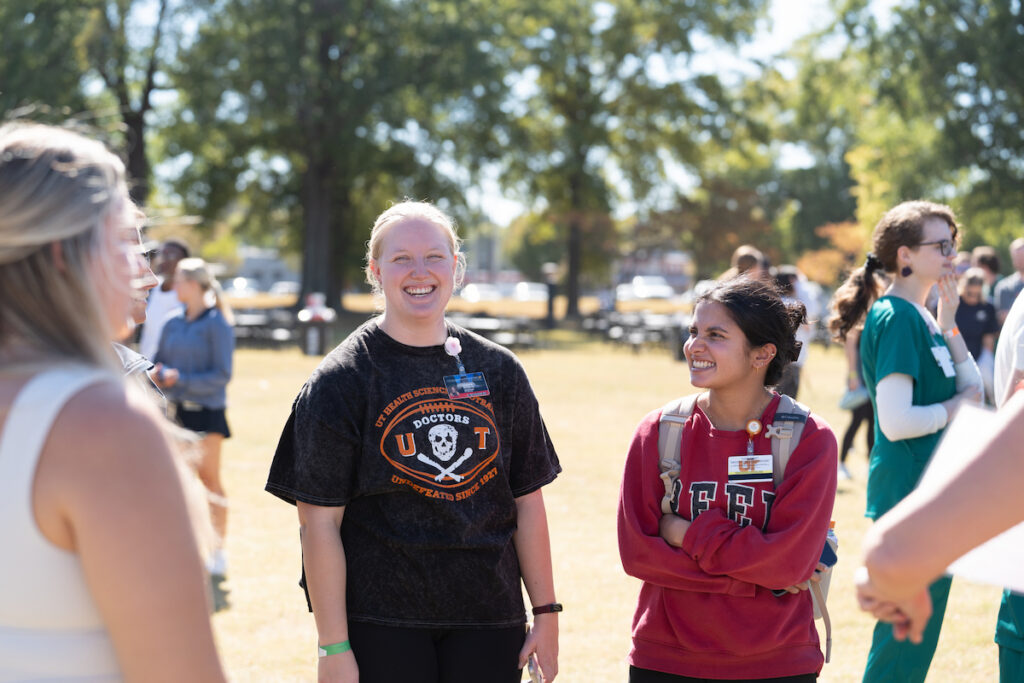
A total of 679 first-year students from all six colleges of the University of Tennessee Health Sciences took part in Interprofessional Education (IPE) Day last week. Of those, 602 swapped classroom seats for mixed teams on Doc’s Field, and 77 joined virtually.
Future dentists, nurses, pharmacists, physicians, and other health professionals and scientists spent the afternoon solving challenges with the colleagues they’ll one day care for patients together.
This year’s event was the first led by Anja Dabelić, MD, the university’s inaugural assistant vice chancellor for Interprofessional Education and Collaborative Practice. Under her leadership, students moved into teams that rotated from station to station. Organizers wanted every student to leave knowing what at least one other profession brings to patient care, long before they meet in a clinic or hospital.
Chancellor Peter Buckley, MD, opened the afternoon by noting how healthcare providers in the past might work on their own, each in a separate silo. “That is not how we do it,” Dr. Buckley said.
Learning Across Professions Early
Dr. Dabelić brings 24 years of Navy Medicine experience to the role, including command of the Navy’s third-largest medical center at Camp Lejeune. On military healthcare teams, she observed a strong openness to what each role could offer in getting the patient better.
She wants students to trade a “this is my lane” mindset for curiosity about what their future teammates know.
Clinicians often lean on quick hallway consults, and a consult only works when a provider knows whom to ask.
“Curbside happens all the time,” she explained. “If you don’t have that network to ask, you’re not only hurting yourself … but the patient’s suffering.”
Swapping Passing Glances for Real Conversations
Many first-year students share a campus but rarely cross program lines.
“We all go to the General Education Building together, but you pass by each other going to different classes, so you don’t really get to interact that much,” said Alexandra “Axie” Cummins, a College of Dentistry student.
Ben LeMarr, a physical therapy student in the College of Health Professions, had a similar experience. “I don’t think I’ve ever talked to anybody outside (my program),” he said. “Not often.”
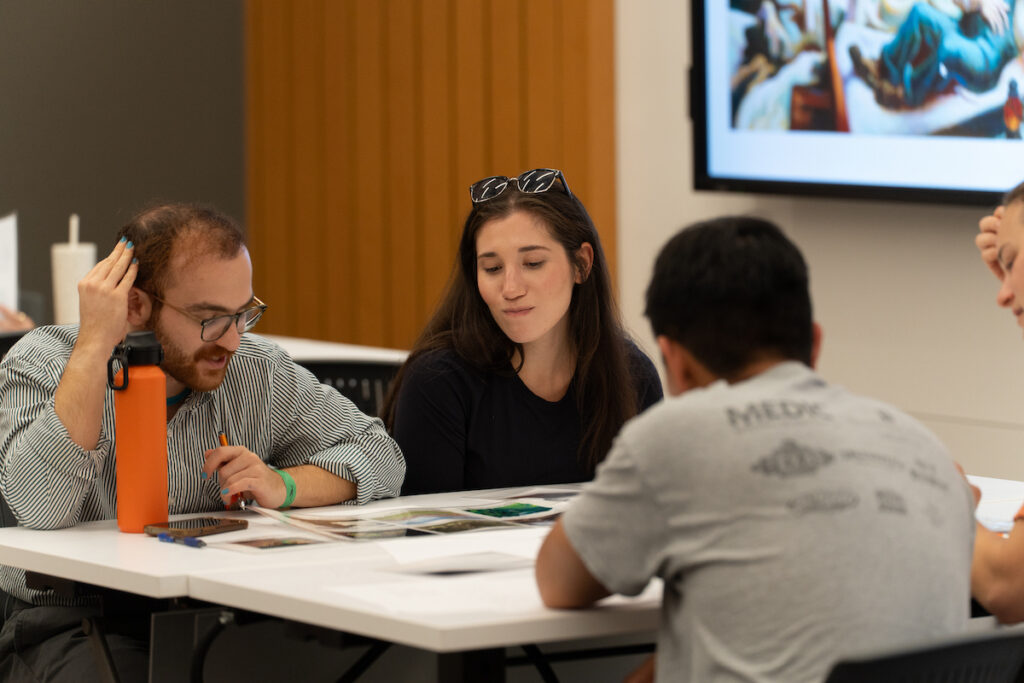
That changed quickly for many on IPE Day. In one huddle, a medical student discussed how diabetes affects teeth with dental classmates. Marissa Clark, a College of Medicine student, found herself on a team with dental hygiene, nursing and medical students.
“I was scared at first because I don’t know these people,” Clark said. “But everyone’s so nice.”
Fernando Mireles Sandoval, a classmate of Cummins in Dentistry, had advice for students who hesitate to mingle on campus. “I would say give it a try,” he said. “I feel like a lot of people here, you can relate to them because they struggled to get where they are too.”
LeMarr sees the value in early introductions as well. He said a recent dental hygiene presentation for physical therapy students covered some familiar ground, but the real payoff was “building that community, because I hadn’t really thought through any of that before.”
What’s New at IPE Day
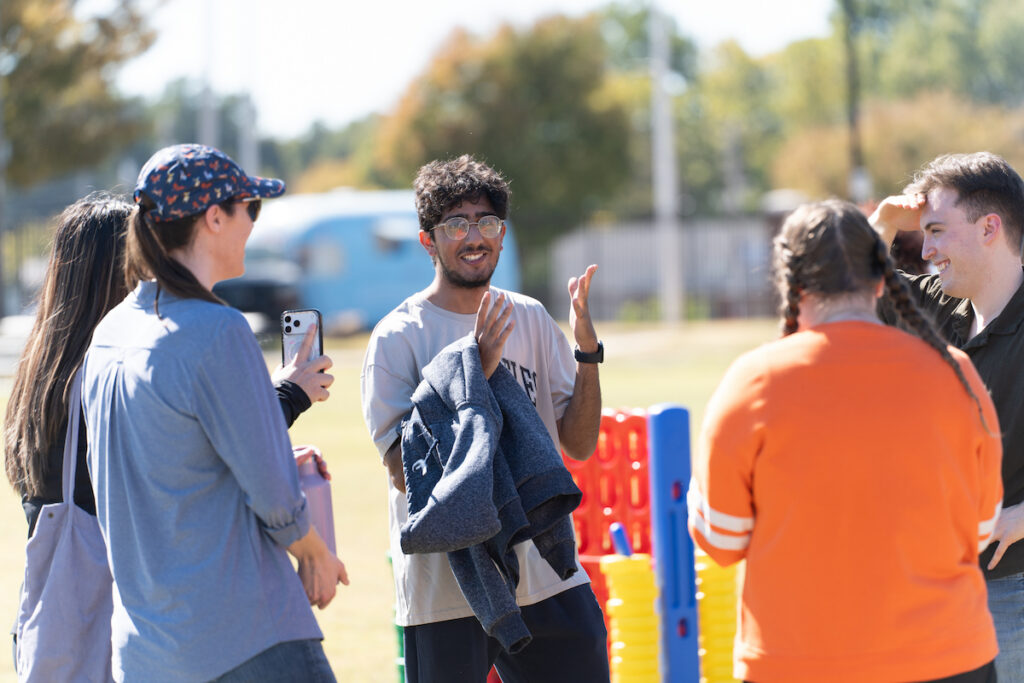
Students wore wristbands in their college’s colors, and each team had to include members from different colleges. They remained with their assigned interprofessional teams throughout the afternoon, allowing them to build relationships and practice collaboration throughout multiple activities.
Stations on the field paired cornhole, ladderball and giant Connect Four with prompts about professional roles and patient care, along with wellness and zine-making activities. Other teams followed a self-paced geocaching game across campus. Upper-level students and faculty designed and led the stations.
“While the activities were designed to be engaging and enjoyable,” said Dr. Dabelić, “their underlying purpose was to help students explore professional roles, strengthen communication and develop collaborative teamwork skills.”
New this year, a Digital IPE Passport let students scan QR codes to track their progress. Students at distance locations joined through a Virtual Escape Room.
Organizers will use this year’s participation data and student reflections to refine future events.
Around the Corner for Interprofessional Education
“IPE Day is more than an opportunity for students to meet their future colleagues,” Dr. Dabelić said. “It is an early step in building a culture where interprofessional collaboration becomes an essential part of how health professionals learn, practice and care for the communities they serve.”
She’s mapping interprofessional learning across all six colleges and exploring an IPE scholar designation for student transcripts. She also hopes to bring nursing, pharmacy and other health profession students into a clinic at Church Health, where medical students already volunteer. Interprofessional teams could also support rural outreach.
Additionally, the $350 million College of Medicine Interdisciplinary Building, which had its groundbreaking Oct. 8, involves plans that call for flexible classrooms, specialty simulation spaces, a technology lab, and formal and informal spaces for group work, all designed to support interdisciplinary instruction.
Before teams scattered across the field and campus on IPE Day, Dr. Dabelić left them with a charge for their education, training and careers. “You’re going to go out and make an enormous difference in Tennessee, so let’s do it together.”