

Established in 1926, the Dental Hygiene Program at what is now the UT Health Sciences College of Dentistry graduated its first class of just four students in 1928. Nearly a century later, the Class of 2026 added 24 graduates to a legacy that has grown to more than 2,300 dental hygiene professionals.
As the program marks its 100th anniversary this fall, its history reflects a century of growth in dental hygiene education, clinical training and patient care. A 1993 archival publication reported more than 1,300 graduates since the program’s founding. By spring 2026, the cumulative total had reached 2,335, according to program anniversary records.
“I think our impact goes beyond the number of graduates,” said Kiesha Werlitz, RDH, BSDH, MS, EdD, department chair and associate professor. “It is the generations of dental hygienists who have entered the profession prepared to provide excellent patient care, educate their communities, and advocate for oral health.”

Established in the College of Dentistry, the program is among the oldest dental hygiene programs in the country. In 1972, it became part of the newly established College of Community and Allied Health Professions, now the College of Health Professions. By the early 1990s, the program awarded bachelor’s degrees and offered clinical experiences in settings that included hospitals and public health institutions. The program subsequently returned to the College of Dentistry in 2014.
For Michelle Miles, MS, BSDH, RDH, a 1993 graduate of the Dental Hygiene Program, who now serves as a faculty member, changes in technology offer a tangible example of how dental hygiene education has advanced.
“We had to check out an ultrasonic unit to use, and today there are units accessible in each cubicle,” Miles said.
Miles recalled using paper charts and radiographic film as a student, compared with computerized charts and digital radiographs now common in clinical training. An out-of-state and first-generation college student, she said the program instilled professional standards and a commitment to excellent patient care that she has carried throughout her career. As an educator, she has also seen former students return to teaching the next generation.
Today, students learn about the connection between oral and systemic health, evidence-based clinical decisions, and caring for patients with complex needs. Their preparation includes experiences across dental specialties, interprofessional learning, and community outreach.
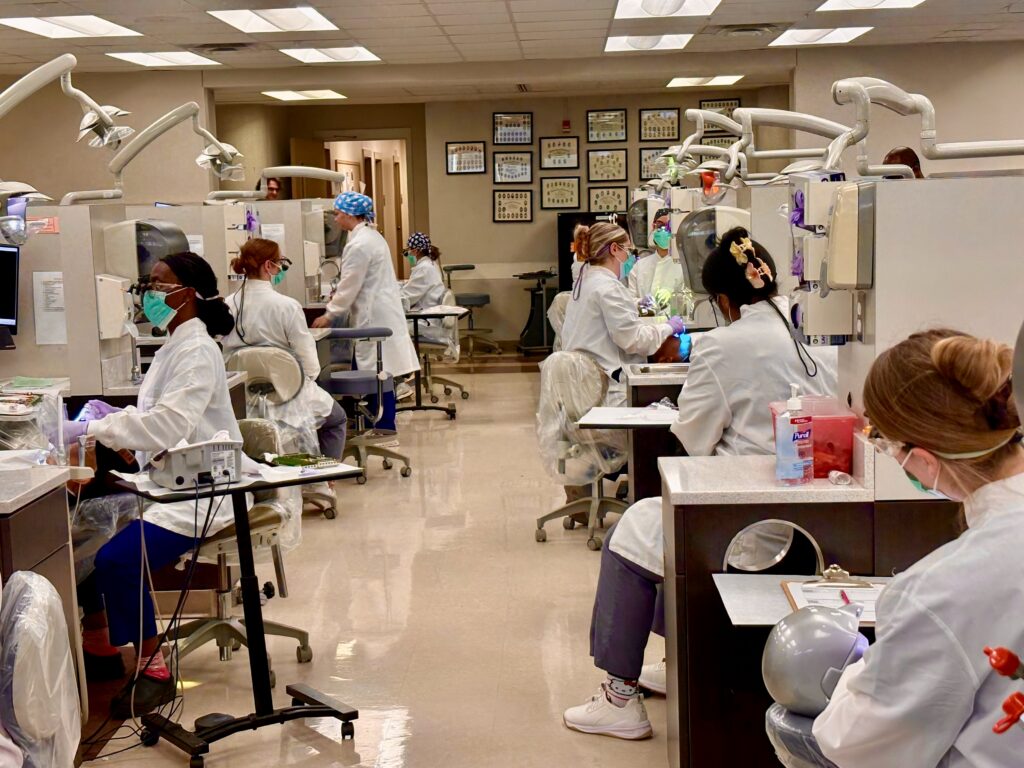
Current dental hygiene student Lauren Anderson said rotations through specialties, such as periodontics and pediatrics, have helped prepare her for professional practice.
“As a hygiene student, I am exposed to new technology, different ways of performing skills, and so much more that truly makes me feel prepared to enter the field,” Anderson said.
Anderson said being a student during the program’s centennial is especially meaningful because it connects her to generations of graduates dedicated to advancing oral health. She hopes to carry that legacy forward by staying current with research and providing high-quality patient care.
Looking to its next century, the program plans to strengthen its curriculum, expand clinical experiences, and incorporate emerging technologies into education and patient care. As part of this continued growth, Dr. Werlitz highlighted plans to introduce a new online Registered Dental Hygienist-to-Bachelor of Science in Dental Hygiene (RDH-to-BSDH) degree completion program. The program will provide practicing dental hygienists across Tennessee and beyond with a flexible pathway to earn their bachelor’s degree and expand their professional opportunities.
The college’s commitment to dental hygiene education extends beyond the classroom. Through the Continuing Education Department, licensed professionals can pursue advanced training and certifications in areas, such as local anesthesia, expanded restorative and prosthetic functions, nitrous oxide administration, and limited prescriptive authority.
“More than anything, I want us to continue building on the strong foundation created over the last 100 years, while still being willing to grow, adapt, and innovate,” Dr. Werlitz said.