
Back in 1939 when Willis C. Campbell, MD, published the first edition of “Campbell’s Operative Orthopaedics,” he included the most current orthopedic surgical practices of the day. Pre-World War II, that meant extensive and aggressive surgical measures, limited medications, lengthy narrative descriptions, and medical illustrations and line drawings.
Today, the 15th edition of what has become the seminal book on orthopaedic surgery, includes the most current minimally invasive techniques, robotic-assisted surgery, brief distillations of trusted procedural recommendations and videos. It even comes with an eBook option.
The intent is the same: to educate physicians on the best practices in orthopaedic surgery and treatment. The legacy continues nearly 90 years since it began, thanks to the generations of orthopedic surgeons trained and working at Campbell Clinic and dedicated to passing the compendium of knowledge on.
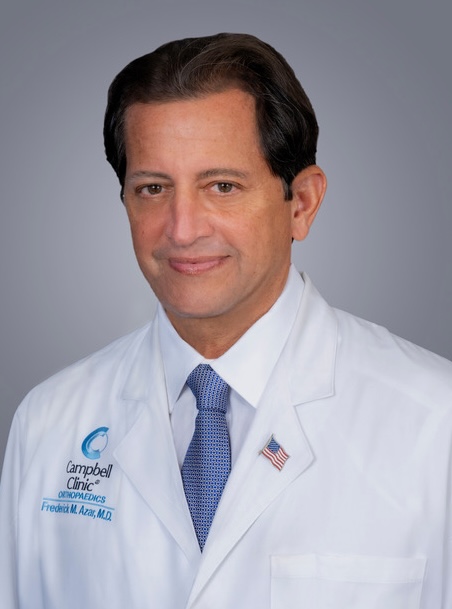
“We’re fiduciaries,” says Frederick M. Azar, MD, one of the three editors of the new four-volume edition of what has become known as “the bible of orthopaedic surgery.”
“We take that responsibility seriously because, ultimately, this book isn’t just about teaching surgeons—it’s about helping them make the best decisions possible for their patients,” he says. “Every improvement we make to this edition has that patient at the center of it.”
On one level, the work is aimed at the physicians around the world who use the book in their own practice. On another level, there is a different focus. “At the end of the day, our end users are the physicians that are trusting us, but the recipients are the patients,” he says.
A Century in Partnership
Dr. Azar is a longtime Memphis physician specializing in sports medicine at Campbell Clinic. He also serves as the Harold Boyd Chair of the UT Health Sciences-Campbell Clinic Department of Orthopaedic Surgery and Biomedical Engineering in the College of Medicine.
Campbell Clinic was founded by Dr. Campbell in Memphis in 1909 and is regarded as a national and international leader in orthopaedics. It operates 30 locations in the southeast with more than 140 providers and more than 1,200 employees.
For more than a century, Campbell Clinic and the University of Tennessee Health Sciences have enjoyed a partnership, formalized by Dr. Campbell, that has shaped orthopaedic surgical care, education and innovation for the Mid-South and the nation.
Physicians at Campbell Clinic have faculty appointments at UT Health Sciences and care for patients at hospitals throughout the Mid-South. Additionally, Campbell Clinic has trained more than 1,000 residents and fellows during the 100-year partnership and is now training physician assistant students, nursing students and other professionals.

“We couldn’t do this without the university,” Dr. Azar says. “We are one of the largest residency training programs in the country. We’re grateful partners with UT Health Sciences, and we feel like they’re a big part of everything we do as it relates to education and research.”
Working Together
In addition to Dr. Azar, editors on the publication were Campbell Clinic physicians Jeffrey R. Sawyer, MD, who specializes in pediatric orthopaedics, and Thomas W. (Quin) Throckmorton, who specializes in shoulder and elbow reconstruction. Both Drs. Sawyer and Throckmorton are professors in the Department of Orthopaedic Surgery and Biomedical Engineering at UT Health Sciences.
“It’s really our legacy,” Dr. Sawyer says. “Very few orthopaedic practices have been around 100-plus years, so it’s one of the common things that we all do as a group, we write the book together.” He has written chapters for previous editions for the past 20 years.
“It’s all Campbell Clinic authors, so it really is how we do surgery at Campbell Clinic,” Dr. Sawyer says. Each staff member was assigned chapters, based on their expertise. Subspecialties, including adult reconstruction; sports medicine; shoulder, elbow, foot and ankle, and hand trauma; pediatrics; the spine; oncology and others, were written by the physicians who are leaders in their fields. “We’re really proud of the new text because it is written for practicing surgeons by practicing surgeons.”
Published by Elsevier, the latest edition is in print in six languages and is distributed to at least 10 countries on six continents.
“I started my training here in 1999, and all of us I think would tell you that we’re grateful and successful because of the Campbell Clinic,” Dr. Sawyer says. “To be able to write the book or edit the book that carries our legacy and our name is an incredible honor.”

“The soul of this book is that it is a ‘how to’ manual for orthopaedic surgery,” says Dr. Throckmorton. “From its inception, it has chronicled not just the standard of care when it comes to medical decision making but also served as a resource to guide surgeons through an operation. It is a massive responsibility to provide high-quality education to enable surgeons around the world to perform their cases safely and effectively. We are grateful to those who came before us who allow us to carry on that legacy.”
The Legacy Continues
Work has already started on the next edition. “It’s basically a nonstop process,” Dr. Sawyer says.
“There are a lot of other good-quality textbooks, but this one’s unique,” Dr. Azar says. “It’s been around longer than any of the other ones and it’s known as being the go-to textbook.”
The 15th edition of “Campbell’s Operative Orthopaedics,” curated and administered by the Campbell Clinic Foundation, is available through major booksellers, including Amazon, and Elsevier. Campbell Clinic also donated a copy to the Benjamin L. Hooks Central Library in Memphis, as a resource for the community.